
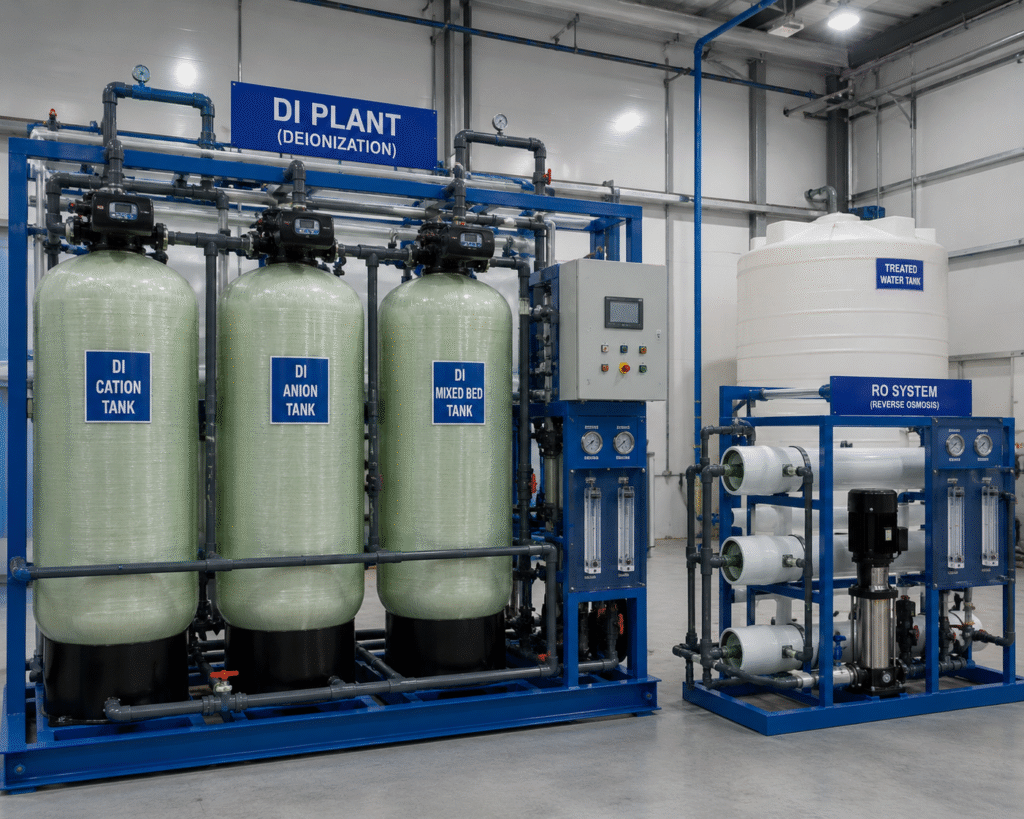
A guy from a pharma facility asked me this last month. “We already have an RO plant,” he said. “Why do we need DI water too?” Fair question, honestly. I get it a lot.
Here’s the short version: RO and DI aren’t really competing. They’re built for different jobs. Let’s go through what each one actually does, and when you truly need DI instead of RO.
What DI Water Actually Means
DI stands for Deionized water. A DI plant strips ions out of water — sodium, calcium, chloride, magnesium, all the charged particles. It uses ion exchange resins to do this. These resins swap out unwanted ions for hydrogen and hydroxide ions. Those two combine and form pure H2O.
What you end up with is water with extremely low conductivity. This gets measured in microsiemens, not TDS. That’s a completely different scale than what most people are used to with RO.
What RO Water Actually Removes
RO stands for Reverse Osmosis. It pushes water through a membrane under pressure. This filters out dissolved solids, bacteria, and most contaminants bigger than the membrane’s pore size. It works well. For drinking water or general industrial use, RO usually gets the job done.
But it has a ceiling. RO typically brings TDS down to somewhere between 10 and 50 ppm. That depends on your source water and the membrane quality. It’s clean water. It’s just not ion-free water.
Where the Real Difference Shows Up
Here’s what most people miss. RO removes most dissolved solids. It doesn’t remove every single ion, though. DI targets those leftover ions specifically. Its resin beds exchange them almost completely.
So if your process needs conductivity below 1 microsiemen, RO alone won’t cut it. You’ll need DI — either as its own system, or as a polishing step right after RO.
When You Actually Need DI Over RO
Not every business needs DI water. Most homes and general commercial setups do fine with RO. But a few industries genuinely can’t run without DI.
Pharmaceutical manufacturing. Drug formulations and injectables need water with zero ionic contamination. Even trace minerals can mess with chemical reactions or shorten shelf life.
Laboratories. Analytical testing — especially with sensitive instruments like HPLC or mass spectrometry — needs water that won’t throw off readings with stray mineral content.
Power plants. Boiler feed water has to be nearly ion-free. Minerals RO leaves behind can cause scaling inside boiler tubes over time. That shortens equipment life and pushes up maintenance costs.
Electronics and semiconductor manufacturing. Even microscopic mineral deposits can damage sensitive components during rinsing or cleaning.
Battery manufacturing. Ion contamination hits battery performance and lifespan directly, so this industry depends heavily on DI water.
RO Plus DI: The Combination That Actually Works
In most industrial setups, it’s not RO versus DI. It’s RO followed by DI. RO does the heavy lifting first — removing bulk dissolved solids, organic matter, and bacteria. Then DI polishes whatever’s left, catching the ions RO couldn’t.
This combo costs less than running DI alone on untreated water. DI resins wear out faster when they’re doing all the work by themselves. Pre-treating with RO stretches resin life a lot, and you regenerate or replace them less often.
Cost Considerations
DI systems usually cost more to run than RO. Resin regeneration is the main reason. Depending on your setup, you’re either swapping resin cartridges regularly or regenerating them with acid and caustic soda. Either way, that adds ongoing cost.
This is exactly why most businesses skip DI unless their process really demands it. If RO-level purity works fine for your product, adding DI just adds cost without adding value.
How to Decide What You Need
A few honest questions to ask yourself:
- Does your process need conductivity below 1-10 microsiemens? Then you need DI.
- Could trace minerals hurt your product quality or your equipment? Then DI’s worth the investment.
- Is your water source already low in TDS? Then a smaller DI unit might be enough — no need for a big system.
- Already running RO? Then adding a DI polishing stage usually costs less than building DI from scratch.
Bottom Line
RO and DI aren’t rivals. They’re tools for different jobs. RO handles general purification well and covers most drinking water and standard industrial needs. DI steps in when your process needs water that’s basically ion-free — pharma, power, electronics, or lab-grade work, mostly.
Not sure which one fits your business? That’s worth figuring out before you spend money on either system.
Epic Aquatech builds and installs both RO and DI systems, plus combined RO-DI setups for industries that need lab-grade or boiler-grade purity. We look at your actual water source and process needs first. That way, you’re not overpaying for purity you don’t need, or falling short on purity you can’t afford to compromise on.