
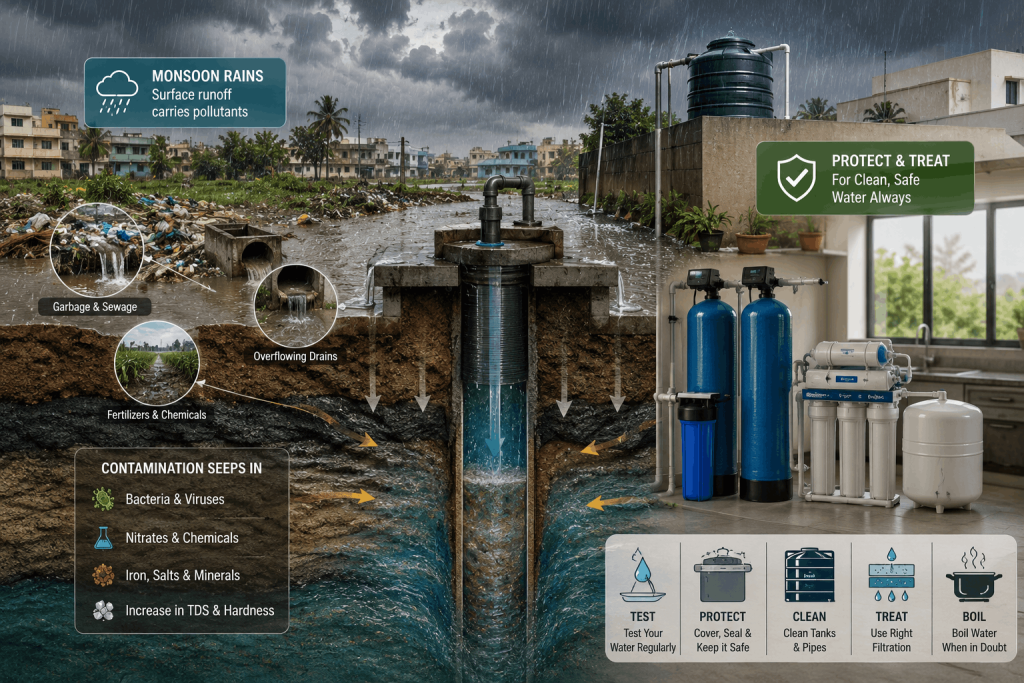
Every year it’s the same story. Summer ends, the first rains arrive, and everyone is happy. But a few weeks later, many borewell owners notice something off. The water looks slightly cloudy. There’s a strange smell. Or it just doesn’t taste the way it did last month.
If that sounds familiar, you’re not imagining things. Borewell water often gets worse during the monsoon, even though more rain should mean more clean groundwater. Here’s why it happens and what you can do about it.
First, why does this happen?
Groundwater feels safe because it’s underground, away from dirt and pollution. But it isn’t sealed off from the surface. Rainwater travels down through soil to reach the water table, and on its way it picks up whatever is lying around.
1. Surface runoff seeps in.
Heavy rain washes everything across the ground: garbage, animal waste, fertilizers, pesticides, oil, and sewage overflow. If your borewell is in a low-lying spot or has a weak or cracked casing, this dirty water can find its way straight in.
2. The water table rises and stirs things up.
During the monsoon, the water table climbs. It can reach layers of soil that were dry for months and carry salts, minerals, and contaminants into your water. That’s why many people suddenly see more iron, a higher TDS level, or a muddy tint.
3. Septic tanks and drains overflow.
In many neighbourhoods, septic tanks, soak pits, and open drains sit close to borewells. When they overflow in heavy rain, bacteria like E. coli can seep into the groundwater. This is one of the biggest reasons for stomach infections, diarrhoea, and typhoid during the rainy season.
4. Flooding around the borewell.
If water collects around the borewell head, it can enter through gaps and unsealed openings. An uncovered or poorly maintained borewell is basically an open invitation for contamination.
5. Fertilizer and chemical leaching.
Near farmland or gardens, rain pushes nitrates and other chemicals deeper into the ground. These don’t change the look of the water much, but they can be harmful, especially for infants and elderly people.
How to tell if your borewell water has gone bad
Some signs are easy to spot:
- Cloudy or muddy water, especially after running the tap for a while
- Yellow or reddish-brown colour (usually iron)
- A rotten-egg or musty smell
- A metallic or salty taste
- Stains on utensils, tiles, or washbasins
- More stomach problems than usual in the family
But remember: clear water is not always safe water. Bacteria and chemicals like nitrates can’t be seen. The only reliable way to know is to test it.
What you should do about it
1. Get your water tested
Right after the monsoon starts, send a sample to a good lab. Ask for basic checks like pH, TDS, hardness, iron, nitrate, and bacterial (coliform) count. It costs very little compared to the medical bills it can save you.
2. Protect the borewell itself
- Keep the borewell head covered and sealed properly.
- Build a raised concrete platform around it so rainwater can’t collect or flow in.
- Fix any cracks in the casing or the surrounding structure.
- Make sure drains and septic tanks are kept at a safe distance, and well maintained.
3. Disinfect the borewell
If you suspect bacterial contamination, the borewell can be disinfected with chlorine (often called shock chlorination). It’s best to have a professional do this so the dosage is right and the system is flushed out properly afterward.
4. Clean your tanks and pipes
Even if the borewell water is fine, a dirty overhead tank can spoil it before it reaches your tap. Clean storage tanks and sumps at least before and after the monsoon.
5. Use the right filtration
There’s no single filter that works for everyone. It depends on what your test report says:
- Sediment filter: for mud, sand, and cloudiness
- Iron removal filter: for reddish or yellow water and metallic taste
- UV or chlorination: for killing bacteria and viruses
- RO system: when TDS, salts, or nitrates are high
- Water softener: for very hard water that leaves scale on everything
Buying an RO just because everyone has one often wastes money and water. Treat what the test shows.
6. Let the borewell run before use
After heavy rain, run the pump for some time and let the first water go out before storing or drinking it. That first flush often carries the most sediment.
7. Boil when in doubt
Until you get your test results, boiling drinking water for a few minutes is a simple and effective safety step.
Don’t wait for the monsoon to end
Many people deal with water problems only when someone falls sick. A better habit is to test twice a year, once before the monsoon and once after. That way you can see exactly what changed and fix it early.
Final thoughts
Borewell water isn’t unsafe by nature. But the monsoon exposes every weakness in your setup: a loose cover, a nearby drain, an old filter, a dirty tank. A little preparation before the rains, followed by a quick test afterward, goes a long way in keeping your family’s water clean and safe.
If your borewell water has changed this season, don’t ignore it. Get it tested, find out what’s actually in it, and choose the treatment that fits.