
Ask most people to explain micro filtration, and they’ll mix it up with ultrafiltration, or just lump it in with basic sand filtration. All three remove particles from water, sure, but they work at completely different scales. Pick the wrong one for your setup, and you either pay for purity you didn’t need, or end up with water that still doesn’t meet your actual requirements.
So let’s get into it — what micro filtration really does, how it works, and where it fits into a water treatment system.
What Is Micro Filtration?
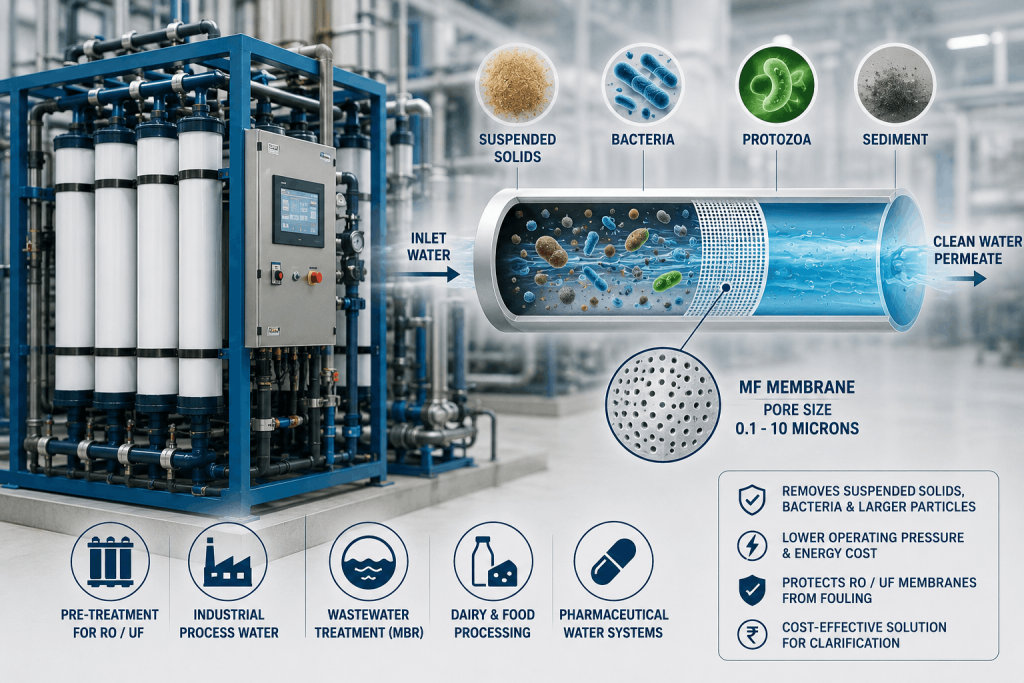
Micro filtration, or MF, is a physical filtration process. It pulls suspended particles, bacteria, and larger microorganisms out of water using a membrane with pore sizes usually between 0.1 and 10 microns. For some perspective, a human hair is around 70 microns wide — so even at the larger end of that range, MF is catching things well below what the eye can see.
Water pushes through the membrane under moderate pressure. Anything bigger than the pore size gets stuck on the surface or inside the membrane structure, while clean water — called permeate — makes it through to the other side.
How It Actually Works
The idea behind it is pretty simple: size exclusion. Think of the membrane as an extremely fine sieve. If something’s physically bigger than the pore size, it’s not getting through, no matter what it’s made of chemically.
Most MF systems use one of two membrane setups.
Hollow Fiber Membranes — thousands of thin, hollow tubes bundled together. Water flows either from inside the fibers outward, or outside in, depending on how the system’s built. This design packs a lot of filtration surface into a small footprint.
Spiral Wound or Flat Sheet Membranes — flat sheets wound around a central core, or laid out in flat panels. You’ll see these more where space isn’t as tight a constraint.
Over time, particles build up on the membrane surface. That’s why most MF systems run a backwashing or air-scouring cycle periodically — it flushes out the accumulated debris and keeps the membrane working at full capacity.
What It Removes (and What It Doesn’t)
MF does a solid job on:
- Suspended solids and anything causing turbidity
- Most bacteria
- Protozoa and larger microorganisms
- Sediment and silt
What it won’t touch:
- Dissolved salts and minerals
- Most viruses (they’re smaller than typical MF pore sizes)
- Dissolved organic compounds
- Color and odor caused by dissolved substances
This is the part people get wrong most often — micro filtration is a physical barrier against particles, not a fix for dissolved contaminants. If your water needs desalination or ion removal, you’ll need RO or ion exchange downstream. MF alone won’t get you there.
Micro Filtration vs Ultrafiltration vs Reverse Osmosis
Quick way to place MF next to its neighbors:
- Micro Filtration: pore size 0.1–10 microns. Handles suspended solids, bacteria, larger particles.
- Ultrafiltration: pore size 0.01–0.1 microns. Catches smaller particles, most viruses, and some larger dissolved molecules.
- Reverse Osmosis: strips out dissolved salts and ions down to near-molecular level, which takes a lot more pressure to run.
Each step down moves to finer filtration and higher pressure demands. In a lot of industrial setups, MF works as a pre-treatment stage ahead of UF or RO — it protects the finer membranes downstream from getting fouled by the bigger particles that would otherwise clog them fast.
Where You’ll Actually Find Micro Filtration in Use
Pre-treatment for RO and UF systems — probably the most common use case. Stripping out suspended solids before water hits RO membranes stretches membrane life considerably and cuts down on fouling-related downtime.
Industrial process water — plenty of manufacturing processes just need particle-free water, without the full demineralization RO provides. MF handles that at a lower running cost.
Wastewater treatment — MF shows up in membrane bioreactor (MBR) systems, separating treated water from biological sludge to produce effluent clean enough for reuse or discharge.
Dairy and food processing — MF pulls bacteria and fat particles out of liquids without needing heat treatment, which helps preserve product quality in certain applications.
Pharmaceutical water systems — used as part of a multi-stage purification setup, often an early clarification step before the finer purification stages kick in.
Why MF Makes Sense for Certain Jobs
The biggest selling point of MF is cost. It runs at much lower pressure than UF or RO, which means lower energy use and less wear on your pumps and system components over time. For jobs where dissolved contaminants aren’t the concern — just suspended particles and bacteria — MF gets you what you need without paying for finer filtration you didn’t actually require.
Final Thought
Micro filtration plays a specific, well-defined role in water treatment — it clears out suspended particles and bacteria at a fraction of what finer membrane technologies cost, while leaving dissolved contaminant removal to UF, RO, or ion exchange systems further down the line. Once you know exactly what MF can and can’t do, you avoid two common mistakes: skipping it and letting particles overload your finer membranes, or over-specifying it when basic sediment removal was all you ever needed. Match the technology to what’s actually in your water, and everything downstream runs a lot smoother for it.
Keywords: micro filtration explained, MF membrane filtration, micro filtration vs ultrafiltration, micro filtration water treatment, industrial micro filtration system, MF pre-treatment for RO, hollow fiber membrane filtration, micro filtration manufacturer, suspended solids removal water, membrane bioreactor MF