
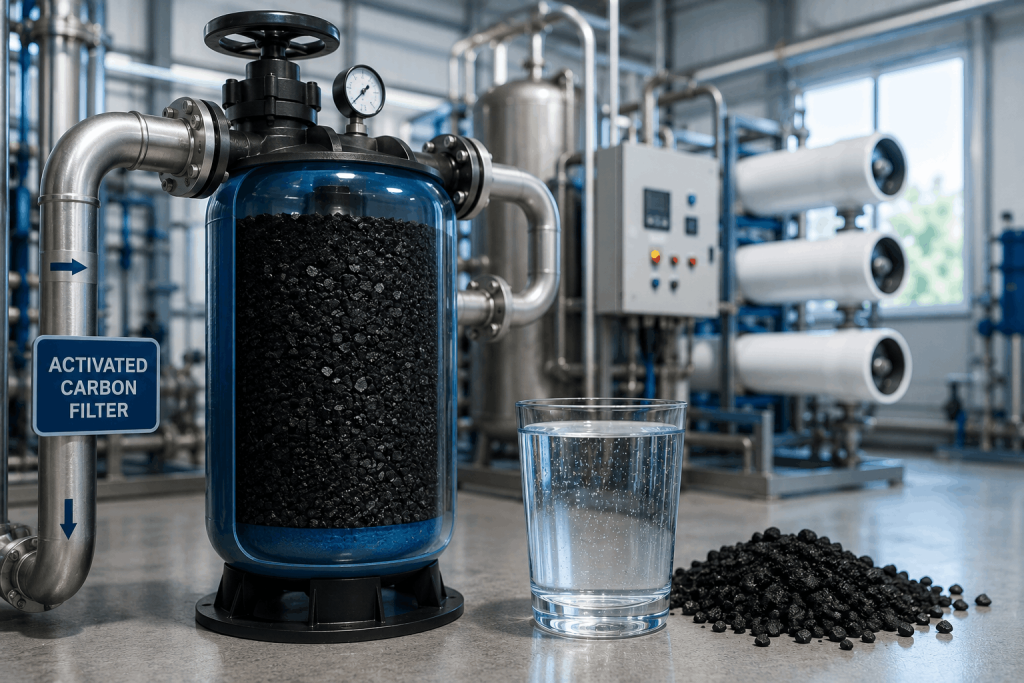
Ever noticed a chlorine smell in treated water, or a faint yellow tint that just won’t go away? Sand filters won’t fix that. Neither will a softener. This is exactly the kind of problem an activated carbon filter solves, and it’s one of the most useful (and most misunderstood) pieces of equipment in a water treatment plant.
So let’s walk through what it actually does, how it works, and how to tell whether your plant needs one.
What Is an Activated Carbon Filter?
An activated carbon filter, often called an ACF, is a pressure vessel packed with carbon granules that have been specially treated to create millions of tiny pores. Those pores give the carbon an enormous internal surface area. Just one gram of activated carbon can have a surface area of 500 square metres or more. That’s roughly the size of two tennis courts packed into a teaspoon.
Water flows through the vessel, and contaminants stick to the carbon surface as it passes. Clean water comes out the other side.
How Does It Work?
The process is called adsorption. Notice the spelling. It isn’t absorption, where something soaks into a material like a sponge. In adsorption, contaminant molecules attach themselves to the surface of the carbon and stay there.
Think of it like iron filings sticking to a magnet. The carbon surface attracts certain molecules and holds on to them. As more water passes through, the available surface slowly fills up. Once it’s full, the carbon can’t hold anything more, and you need to replace or reactivate it.
What Does It Remove?
Activated carbon does very well with:
- Free chlorine and chloramines
- Bad taste and odour
- Organic compounds and some pesticides
- Colour caused by organic matter
- Certain industrial chemicals and solvents
It doesn’t do much for:
- Dissolved salts and minerals (that’s RO or DM plant territory)
- Hardness (you need a softener for that)
- Bacteria and viruses
- Heavy metals in most cases
That last list matters. People sometimes expect an ACF to make water “pure.” It won’t. It cleans up specific problems, and it works best as one stage in a larger treatment train.
Why Chlorine Removal Matters So Much
Here’s the reason most industrial plants install an ACF. Chlorine destroys RO membranes. Even small amounts, over time, damage the membrane material and kill its ability to reject salts. Replacing a set of RO membranes costs far more than a carbon filter ever will.
So in most RO and DM systems, the ACF sits right before the membrane or ion exchange stage. It strips out chlorine and organics first, and the sensitive equipment downstream stays protected.
Where You’ll Find ACFs in Use
Before RO plants. This is the most common setup. Chlorinated municipal water or treated borewell water passes through the ACF before it reaches the membranes.
In DM and mixed bed plants. Organic matter fouls ion exchange resins quickly. Carbon filtration upstream keeps the resin working longer.
In food and beverage units. Taste and odour control matters here, so carbon filtration polishes the water before it goes into production.
In textile and dyeing plants. Operators use carbon to deal with organic load and colour in process water.
In commercial buildings. Hotels, hospitals, and office complexes use ACFs to improve the taste and smell of tap water.
When Do You Actually Need One?
A few signs point toward needing an ACF:
- Your water smells or tastes of chlorine
- You’re feeding chlorinated water into an RO or DM plant
- Your water has organic colour or odour
- Your resins or membranes are fouling faster than expected
- Your product quality depends on neutral-tasting water
If none of these apply, and you’re working with clean, unchlorinated groundwater, you might not need one. Skipping unnecessary equipment saves real money.
Sizing and Design Basics
A few factors decide how well an ACF performs.
Contact time. Water needs enough time inside the vessel for adsorption to happen. Too fast, and contaminants slip through. Designers size the vessel so water spends the right amount of time in the carbon bed.
Flow rate. Every vessel has a recommended flow rate per unit area. Push past it, and performance drops.
Carbon quality. Not all carbon is equal. Coconut shell carbon, coal-based carbon, and wood-based carbon each have different pore structures and suit different jobs. Coconut shell carbon works well for chlorine and taste removal. Coal-based types handle some organic compounds better.
Backwashing. Carbon beds trap sediment too, so regular backwashing keeps the bed loose and prevents channeling, where water finds shortcuts through the carbon and skips the adsorption surface.
Maintenance: What to Watch For
Carbon doesn’t last forever. Most plants replace the media every one to three years, depending on water quality and usage. A few warning signs tell you it’s time:
- Chlorine shows up in the outlet water
- Taste or odour returns
- Pressure drop across the vessel climbs
- Water quality tests show organic levels rising
One more thing. A saturated carbon bed can actually grow bacteria, since it holds organic matter that microbes feed on. That’s another reason not to leave old carbon sitting in the vessel.
Final Thought
An activated carbon filter isn’t flashy, but it does a job nothing else in your plant can do. It strips out chlorine and organics before they damage the expensive parts of your system downstream. Test your water, check whether chlorine or organic matter is present, and size the vessel properly. A well-designed ACF protects your RO membranes, improves water quality, and costs very little compared to the equipment it keeps safe.
Keywords: activated carbon filter, ACF filter water treatment, activated carbon filter for RO plant, chlorine removal from water, activated carbon filter manufacturer, carbon filter industrial water treatment, how activated carbon filter works, ACF vessel design, coconut shell carbon filter, activated carbon filter maintenance