
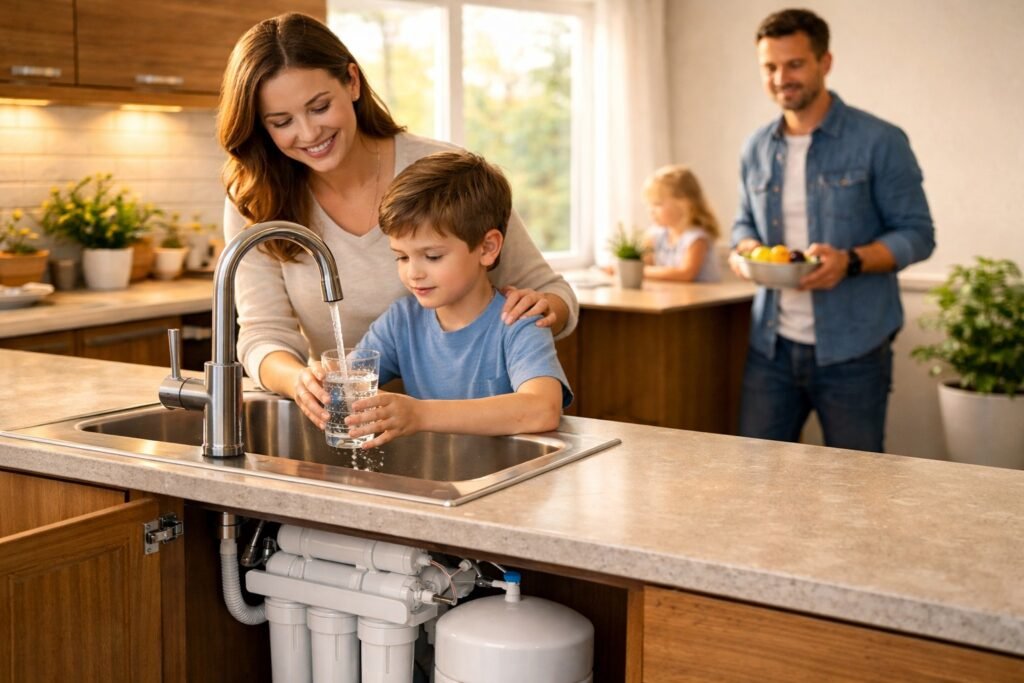
Most people don’t think about water until something goes wrong.
Maybe the kettle starts forming white deposits. Maybe the tap water smells slightly different. Or maybe someone in the family keeps getting stomach issues and you can’t figure out why.
Water feels basic. Ordinary. It’s always there. But the quality of that water quietly affects more things than we realize — from our health to our machines, from household expenses to business performance.
Let’s talk about why it actually matters.
At Home: It’s More Than Just Drinking
When we say “clean water,” most people think about drinking water. But that’s only part of the picture.
The same water runs through your kitchen, bathroom, washing machine, geyser, and pipes. If it contains excess minerals, chemicals, or contamination, the effects slowly start showing up:
- White scaling on taps and showerheads
- Reduced water flow in pipelines
- Geysers consuming more electricity
- Dry skin and rough hair
- A strange aftertaste in tea or food
These aren’t dramatic problems at first. They creep in slowly. Over time, though, they increase repair bills and reduce appliance life.
And of course, there’s health. Contaminated water may look clean but still carry bacteria, heavy metals, or dissolved salts. Especially for children and elderly family members, that risk isn’t something to ignore.
Clean water simply makes everyday life smoother — in ways we don’t notice until the quality drops.
For Businesses: Water Quality Is Operational Stability
In homes, poor water is inconvenient.
In businesses, it can be expensive.
Think about industries that rely on boilers, cooling towers, food preparation, or manufacturing processes. Water is not just a utility there — it’s part of the system.
Hard water leads to scaling.
Scaling reduces efficiency.
Reduced efficiency increases energy costs.
And eventually, systems fail earlier than expected.
That means downtime. Repairs. Replacement parts. Sometimes even compliance issues.
In sectors like hospitality, healthcare, food processing, and pharmaceuticals, water quality directly affects service quality and brand trust. Customers may never see your water system — but they experience its results.
The Changing Reality of Water in India
Across many cities, groundwater quality has changed over the years. Rapid urban growth, industrial discharge, and overuse of borewells have increased:
- High TDS levels
- Hardness
- Chemical contamination
- Sewage mixing in some areas
Depending only on municipal supply is no longer enough. Two homes in the same area can have different water quality depending on source and plumbing conditions.
That’s why testing matters. Not guessing. Not assuming.
Prevention Is Always Cheaper Than Repair
One common mistake people make is waiting until there’s visible damage.
They install a system only after appliances fail.
They treat water only after health issues arise.
They maintain plants only after breakdowns.
But water treatment works best as prevention.
When water is treated properly:
- Appliances last longer
- Energy consumption drops
- Plumbing stays cleaner
- Maintenance frequency reduces
- Health risks decrease
- It’s not just about purification. It’s about protection.
Clean Water Is a Long-Term Decision
Water is something we use daily without thinking. But once quality becomes a problem, it affects daily life constantly.
Choosing proper water treatment isn’t about luxury or overengineering. It’s about making sure the basics of your home or business are reliable.
Because when water quality is right, everything else functions better — quietly, efficiently, without unnecessary problems.