
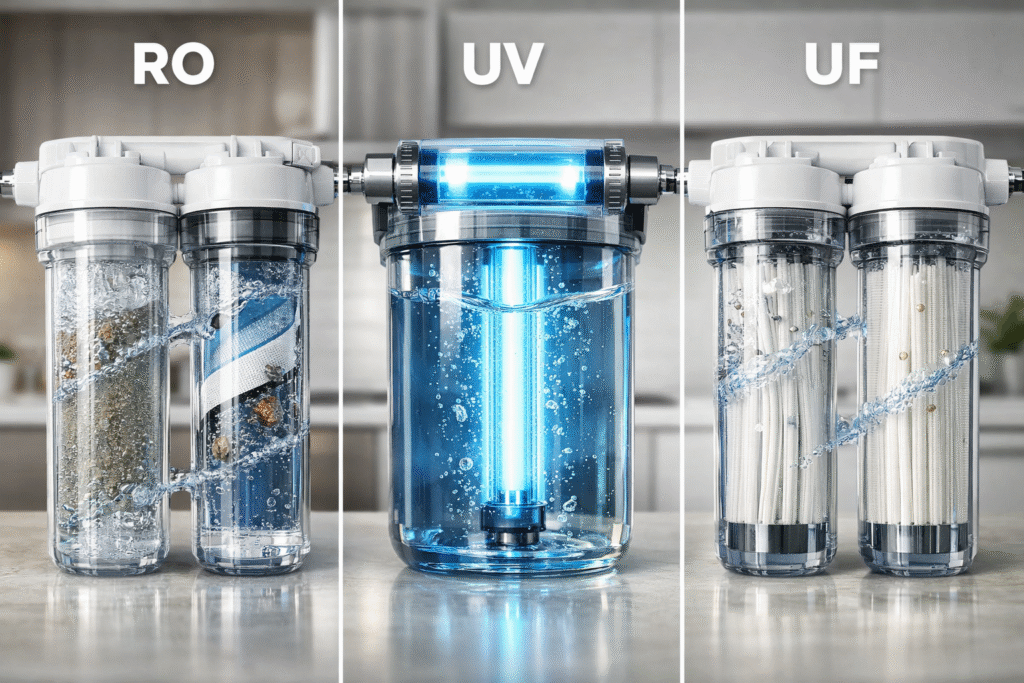
RO vs UV vs UF Which Water Purifier Is Best
If you’ve ever stood in a shop or scrolled online trying to pick a water purifier, you’ve probably seen these three everywhere — RO, UV, UF.
And honestly, most people just nod like they understand it… even when they don’t.
Because the way it’s usually explained feels too technical. Membranes, filtration stages, wavelengths — it starts sounding like a science class.
But in real life, the difference is much simpler.
It depends on what your water is like
This is the part most people skip.
They don’t check the water. They check the offers.
Someone nearby installed an RO, so they do the same. Or the shop guy says “this is the latest model,” and that’s enough.
But water isn’t the same everywhere. Even in the same building, it can vary depending on source and plumbing.
So instead of asking “which purifier is best,” it actually makes more sense to ask — what’s wrong with my water?
RO usually shows the biggest change
If you’ve ever had water that tastes a bit salty or heavy, you’ll know what I mean.
That’s where RO comes in. It removes a lot of dissolved stuff from the water — the kind that changes taste and leaves deposits behind.
People who switch to RO in those cases usually notice the difference immediately.
But here’s something people realise later — if the water wasn’t that bad to begin with, RO can make it feel… too light. Almost like something is missing.
So it’s not wrong. It just needs the right situation.
UV is more like a safety layer
UV doesn’t really change how water tastes.
You won’t drink it and say, “this feels different.”
What it does is deal with things you can’t see — bacteria, microorganisms, the kind of stuff that becomes a problem if storage tanks or pipelines aren’t clean.
So UV is more about peace of mind than visible change.
If your water already looks and tastes fine, but you’re unsure about its safety, UV starts making sense.
UF is the one people rarely ask about
A lot of people don’t even hear about UF unless someone specifically explains it.
It’s simpler. It handles basic filtration — particles, some impurities — without getting too complicated.
In places where water isn’t heavily contaminated, UF can actually be enough.
But since it doesn’t deal with dissolved salts, it won’t fix taste issues caused by high TDS.
That’s where people get confused — they expect one system to solve everything.
Why people end up with all three
You’ll see purifiers that say RO + UV + UF.
At first, it feels like overkill.
But in some homes, water has mixed issues. A bit of everything — taste, impurities, safety concerns.
So instead of choosing one, systems combine them.
Still, that doesn’t mean you automatically need all three. Sometimes it’s just how products are marketed — more features, more appeal.
Where things usually go wrong
Most decisions are made in a hurry.
No testing. No real understanding. Just a quick choice based on what sounds advanced.
And then later, small complaints start coming in:
“Water tastes different.”
“Pressure is low.”
“Filters need changing too often.”
Nothing major. Just enough to feel like something isn’t quite right.
The easier way to look at it
Forget the technology for a second.
Think about what you’re actually noticing:
- If the taste is off → something like RO is probably needed
- If you’re worried about hygiene → UV helps
- If it’s just visible dirt or particles → UF can handle that
That’s it.
Once you connect it to what you’re experiencing, it stops feeling confusing.