
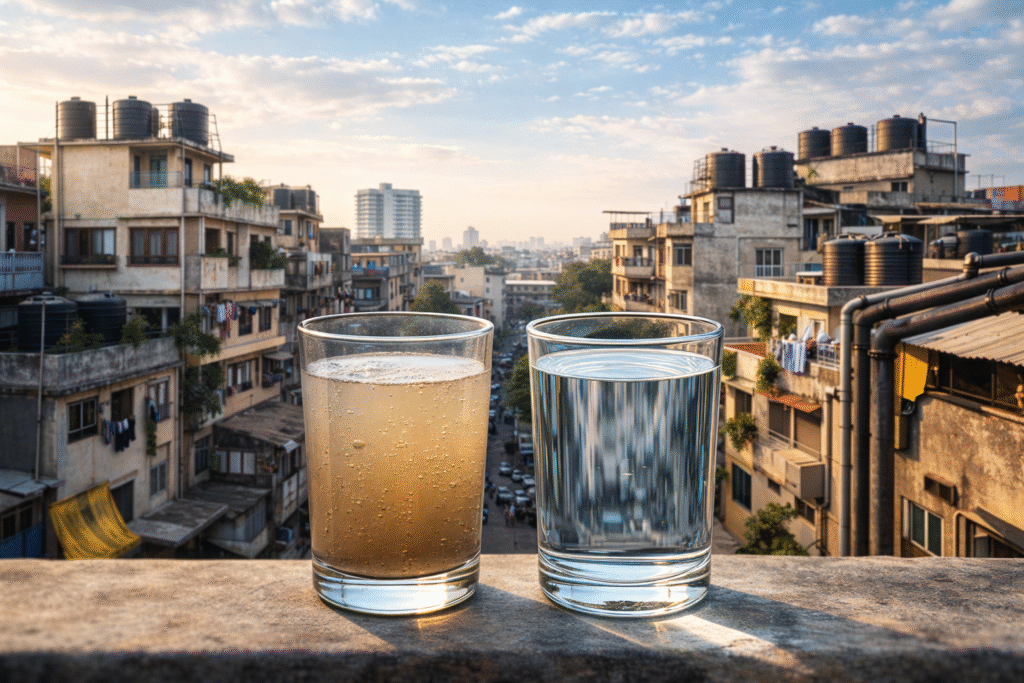
Water quality problems in Indian cities (Introduction)
If you’ve ever shifted from one area of a city to another, you might have noticed something interesting — the water feels different.
In one place, soap doesn’t lather properly.
In another, there’s a slight smell.
Some homes struggle with scaling, while others deal with cloudy tap water.
Water quality in Indian cities isn’t uniform. It changes from locality to locality, sometimes even building to building. And the reasons behind it are more practical than most people think.
Let’s look at the common problems people face — and what realistically helps.
Hard Water: The Most Common Complaint
If taps turn white, showerheads clog, or geysers lose efficiency, the issue is usually hardness.
Hard water contains excess calcium and magnesium. It’s not immediately dangerous to drink, but it slowly damages plumbing and appliances. Over time, scaling builds up inside pipelines, reducing flow and increasing electricity consumption in heaters.
In many cities, especially where borewell water is used, hardness levels are high.
What helps?
A properly sized water softener for the building or home. Not a small, temporary solution — but a system designed based on actual water testing. Once hardness is controlled, the difference in maintenance costs becomes noticeable.
High TDS Levels: When Water Tastes “Heavy”
In several urban areas, Total Dissolved Solids (TDS) levels are higher than recommended limits. This often happens due to groundwater depletion and mineral concentration.
High TDS water may taste salty or metallic. Over time, it can affect health, especially if heavy metals are present.
But here’s the important part — not all high TDS water needs aggressive treatment. The right solution depends on the exact composition.
What helps?
Water testing first. Then, if required, a Reverse Osmosis (RO) system designed according to daily usage. Oversizing or undersizing both create problems later.
Chemical Contamination
In industrial zones or rapidly developing areas, groundwater sometimes carries chemical traces. These may include nitrates, fluoride, or other dissolved contaminants.
The challenge is that you cannot detect these by taste or smell. The water may look perfectly clear.
What helps?
Regular lab testing, especially for commercial properties and residential societies. Treatment methods vary — activated carbon filters, RO systems, or specialized filtration depending on the contaminant.
Microbial Contamination
In areas where sewage lines and water pipelines run close together, leakages can cause bacterial contamination. During monsoon season, this risk increases.
This is where waterborne illnesses become a real concern.
What helps?
UV purification for drinking water and proper maintenance of storage tanks. In apartments, periodic tank cleaning is often ignored — but it makes a huge difference.
Aging Infrastructure
Sometimes the issue isn’t the source — it’s the plumbing.
Old pipelines corrode. Storage tanks collect sediment. Internal plumbing affects final output. So even if municipal water supply is treated, what reaches the tap may not be ideal.
What helps?
Periodic inspection. Flushing pipelines. Replacing damaged plumbing sections instead of repeatedly treating symptoms.
The Bigger Picture
Water problems in Indian cities are rarely dramatic overnight issues. They develop slowly.
A little scaling here.
A slight taste difference there.
A small maintenance bill that keeps repeating.
Most people adjust to it instead of addressing it.
But the cost of ignoring water quality adds up — through appliance repairs, energy waste, plumbing damage, and health risks.
The Practical Approach
The smartest approach is simple:
- Test the water.
- Understand the specific issue.
- Install only what is necessary.
- Maintain it properly.
Not every home needs a large system. Not every building needs the same solution. Water treatment works best when it is customized, not copied.