
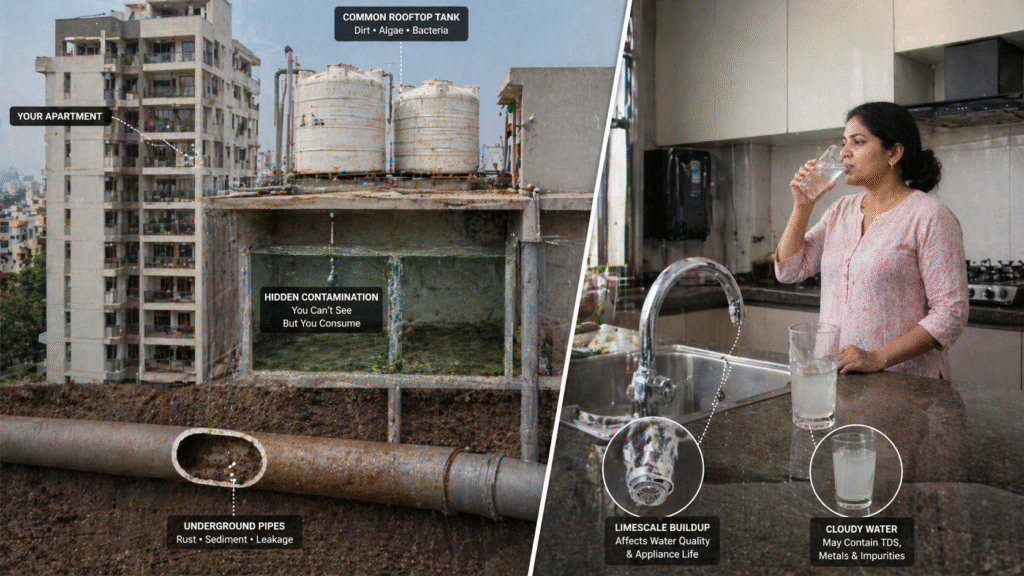
What Most People Miss About Water in Apartments and Societies
When people move into a new apartment, they usually check the basics.
Location.
Parking.
Power backup.
Security.
Water is almost always assumed to be “taken care of.”
After all, if the building is new or well-maintained, how bad could it be?
But after a few months, small things start to feel off.
It’s Not Just About Supply
In most societies, water availability isn’t the only issue anymore.
There’s usually enough water — through municipal supply, borewells, or tankers.
The real question is: what kind of water is actually reaching your tap?
Because by the time water reaches individual flats, it has already gone through storage tanks, pipelines, and sometimes mixing of different sources.
Each step changes its quality.
Different Flats, Different Experience
Two families in the same building can have completely different experiences with water.
One complains about scaling.
Another notices a smell.
Someone else has no visible issue but still doesn’t trust the taste.
It sounds strange, but it happens more often than people think.
Internal plumbing, storage conditions, and usage patterns all play a role.
Overhead Tanks Are Rarely Thought About
Most people don’t see the building’s water tanks — so they don’t think about them.
But those tanks quietly affect everything.
If they aren’t cleaned regularly, sediment builds up.
If lids aren’t sealed properly, contamination becomes possible.
And whatever happens there eventually reaches every tap in the building.
Mixing of Water Sources Changes Things
Many societies rely on more than one source.
Borewell water during one part of the day.
Tanker water when supply runs low.
Municipal water when available.
Each source has different characteristics.
So the water quality you get isn’t consistent. It shifts depending on what’s being used at that time.
That’s why sometimes the water feels fine… and sometimes it doesn’t.
The Problem Shows Up in Small Ways
People rarely connect daily issues with water quality.
Frequent cleaning of bathroom fittings
Clothes not feeling fresh after washing
Appliances needing repeated servicing
These are usually treated as separate problems.
But often, they trace back to the same root — untreated or inconsistently treated water.
Society-Level Treatment Isn’t Always Enough
Some buildings do have basic treatment systems in place.
But “installed” doesn’t always mean “working optimally.”
Systems need regular monitoring.
Settings need adjustment based on water quality changes.
Maintenance needs to be consistent.
Without that, even a good setup can lose effectiveness over time.
Individual Solutions Start Coming In
This is where residents start taking things into their own hands.
Some install purifiers just for drinking water.
Others look at softeners or filters for their flats.
It’s not because the society has no system — it’s because the common system doesn’t fully solve every issue.
A More Practical Way to Look at It
Instead of assuming water is “fine,” it helps to treat it like any other utility.
Something that needs occasional checking.
Not overthinking. Just basic awareness.
Understanding:
- Where the water is coming from
- Whether it’s being treated properly
- If what you’re experiencing is normal or not
That alone clears up a lot of confusion.
It’s Not About Overreacting
Most water issues in apartments aren’t extreme.
They’re subtle.
But subtle problems, when ignored for long enough, turn into recurring inconvenience — and eventually, cost.