
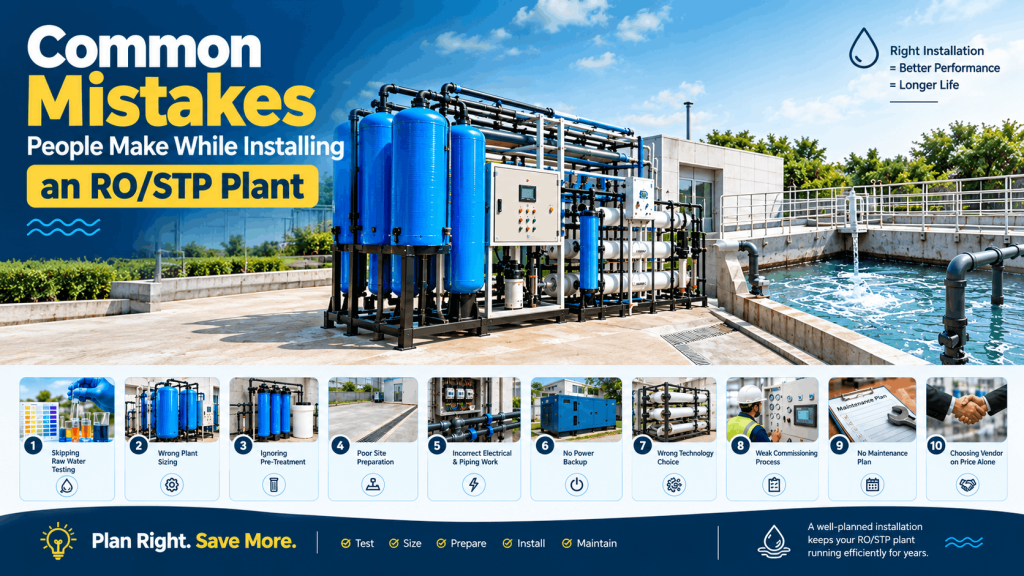
Most problems with an RO or STP plant don’t start after installation — they start during it. By the time someone notices low output, frequent breakdowns, or a plant that just never performs the way it was supposed to, the real issue usually traces back to a decision made before the equipment even arrived on site.
Here’s a rundown of the mistakes that come up again and again, whether it’s a residential RO system or a full STP for a commercial building.
1. Skipping Raw Water Testing Before Sizing the Plant
A lot of buyers jump straight to picking capacity and technology without testing their raw water first. TDS, hardness, iron content, pH, and bacterial load all affect what kind of pre-treatment and membrane configuration you actually need.
Install a plant sized for “average” water when your source carries unusually high iron or hardness, and you’ll see fouling, reduced membrane life, or output quality that never quite hits the mark. Testing raw water first isn’t an optional step — it’s what the entire design should be based on.
2. Undersizing or Oversizing the Plant
People often size a plant based on current need alone, ignoring future growth or peak demand. An undersized plant runs constantly under strain, cutting its lifespan short. An oversized plant costs more upfront and runs inefficiently at partial load most of the time.
The right approach accounts for daily peak usage, not just average consumption, and leaves some headroom for growth — especially for commercial and residential society setups where occupancy tends to increase over time.
3. Ignoring Pre-Treatment
This mistake shows up constantly. Buyers focus all their attention on the RO membrane or the biological treatment stage, and treat pre-treatment (sand filters, carbon filters, softeners, strainers) as an afterthought or a cost to cut.
Pre-treatment protects everything downstream. Skip it or undersize it, and you’re sending unfiltered sediment, chlorine, or hardness straight into components that are far more expensive to repair or replace than a filter would have cost.
4. Poor Site Preparation
Plants get installed on uneven flooring, in spaces with no drainage provision, or in locations with no room for future maintenance access. This causes problems almost immediately — vibration issues, water pooling around equipment, or technicians struggling to even reach valves and panels during routine servicing.
Before installation day, the site needs a level foundation, proper drainage, adequate ventilation, and enough clearance around the plant for someone to actually work on it later.
5. Incorrect Electrical and Piping Work
Loose electrical connections, undersized cables, or piping laid without proper slope and support are some of the most common installation-stage errors. These issues often don’t show up on day one — they surface weeks or months later as pump failures, leaks, or pressure inconsistencies.
Electrical work should match the plant’s actual load requirements, not just whatever wiring happened to already be on site. And piping needs correct slope, support brackets, and the right pipe material for the water being carried — especially for STP piping, which deals with far more aggressive conditions than clean water lines.
6. Not Accounting for Power Backup
Both RO and STP plants need continuous or near-continuous operation to function properly. STPs in particular rely on continuous aeration for biological treatment — frequent power cuts without backup can disrupt the biological process entirely, sometimes requiring a fresh restart of the treatment cycle.
Skipping a backup power provision to save cost at installation time often turns into a recurring operational headache later.
7. Choosing the Wrong Technology for the Application
Not every STP needs an MBR system, and not every RO plant needs industrial-grade membranes. Buyers sometimes end up with over-engineered systems because a vendor pushed premium technology, or under-engineered systems because someone wanted to save money without understanding the trade-off.
Technology choice should match the actual water quality target, space constraints, and budget — not just what’s trending or what a vendor happens to be promoting that quarter.
8. Weak or Missing Commissioning Process
Installation isn’t finished just because the equipment is connected and switched on. A proper commissioning process checks flow rates, pressure levels, membrane performance, output water quality, and alarm systems before the plant goes into regular use.
Skip this step, and small configuration issues go unnoticed until they turn into bigger failures weeks later — at which point troubleshooting becomes far more time-consuming than it would have been during commissioning.
9. No Documented Maintenance Plan From Day One
Plants installed without a clear maintenance schedule — filter replacement intervals, membrane cleaning frequency, sludge removal timeline for STPs — tend to get neglected until something visibly breaks. Reactive maintenance always costs more than preventive maintenance, both in repair costs and in plant downtime.
Setting up a maintenance calendar at the time of installation, not months later, keeps the plant running at its designed efficiency for much longer.
10. Choosing a Vendor Based on Price Alone
The cheapest quote often leaves out things like civil work, electrical fittings, commissioning support, or warranty coverage — costs that show up later as “extra” charges, or worse, as corners cut on equipment quality. A detailed quote comparison, not just a bottom-line number, usually reveals which vendor is actually offering a complete, properly engineered system.
Final Thought
Almost every expensive problem with an RO or STP plant traces back to a decision made before commissioning — not a flaw in the equipment itself. Test your water, size the plant properly, don’t shortcut pre-treatment, and get the site and electrical work right from the start. A plant installed carefully the first time costs less over its lifetime than one that needs constant troubleshooting because a few early steps got skipped to save a bit of time or money upfront.
Keywords: RO plant installation mistakes, STP installation mistakes, common mistakes RO plant setup, sewage treatment plant installation errors, RO plant pre-treatment mistakes, water treatment plant commissioning, STP plant maintenance mistakes, RO plant sizing mistakes, industrial RO plant installation, STP plant site preparation