
If you’ve spent any time researching water purifiers, you’ve probably run into these two terms and thought, “wait, aren’t these the same thing?” Fair question. Both use membranes, both filter water, both get thrown around in product descriptions like they’re interchangeable. They’re not. And once you understand where they actually differ, choosing between them gets a lot easier. It also explains why your purifier might use both.
It Really Just Comes Down to Pore Size
Here’s the simplest way to think about it. Both technologies push water through a membrane full of microscopic holes. Anything bigger than those holes gets left behind. The only real difference is how small the holes are.
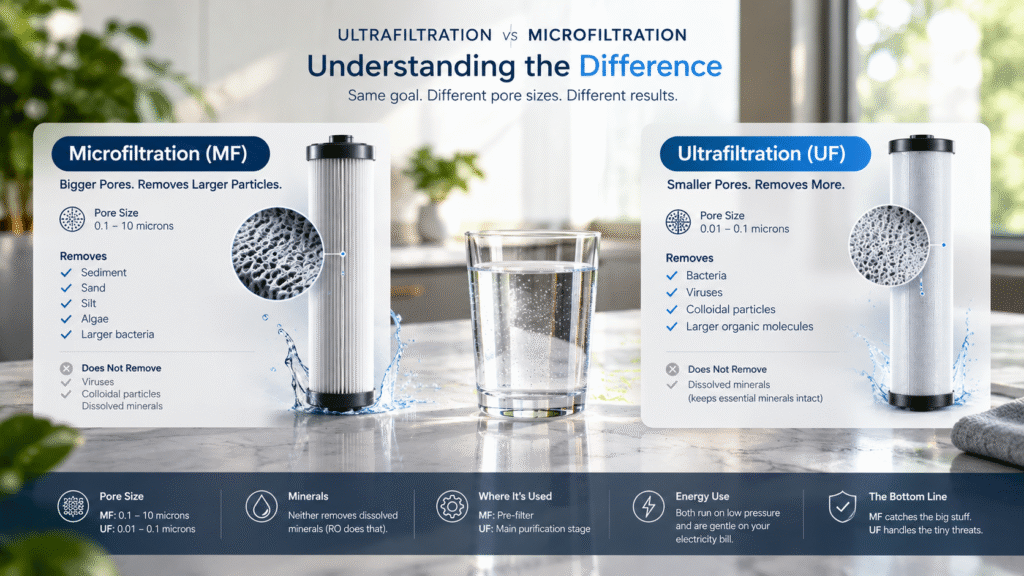
Microfiltration (MF) membranes usually sit somewhere between 0.1 and 10 microns. Ultrafiltration (UF) membranes are much tighter — typically 0.01 to 0.1 microns. Doesn’t sound like a huge gap when you write it out like that. But in practice, that gap decides what actually makes it through the membrane and what doesn’t.
So What Does Microfiltration Actually Catch?
Think sediment, sand, silt, algae, and the bigger bacteria. That’s MF’s job. You’ll often find it used as a first line of defense. It’s a pre-treatment stage that clears out the visible junk before water moves on to something finer.
What it won’t catch is viruses, or the really tiny colloidal stuff floating around. It’s built for clarity, not complete purification. If your water just looks cloudy or has visible particles, MF alone might already solve that.
And Ultrafiltration Takes It Further
UF picks up where MF leaves off. Because the pores are so much finer, it can pull out bacteria, most viruses, colloidal particles, and even some larger organic molecules. Dissolved minerals still pass through, untouched.
That last part matters more than people realize. A lot of buyers assume “more filtration = better.” But UF actually strikes a nice balance — it removes what could make you sick, without stripping the water of minerals the way reverse osmosis tends to. That’s a big reason UF has become the go-to choice for household purifiers. It especially makes sense where the main worry is bacterial contamination rather than dissolved salts or heavy metals.
Putting Them Side by Side
- Pore size: MF is coarser (0.1–10 microns); UF is much finer (0.01–0.1 microns)
- What each removes: MF handles sediment, silt, and larger bacteria. UF adds bacteria, most viruses, and colloidal matter on top of that
- Minerals: Neither strips out dissolved minerals — that’s a job left to reverse osmosis
- Where they’re used: MF often works as a pre-filter; UF usually does the heavy lifting as the main purification stage
- Energy use: Both run on relatively low pressure, so they’re gentler on your electricity bill than RO systems
Which One Do You Actually Need?
Honestly, it depends on your water source — there’s no one right answer here. If you’re mostly dealing with visible sediment or turbidity, say from surface water or older pipes, microfiltration alone might get the job done. Or it could at least handle the first stage.
But if bacteria or viruses are the concern, ultrafiltration is the stronger option. The same goes if you just want clean drinking water without losing the natural minerals in it. And that’s exactly why most modern purifiers don’t pick one over the other — they stack both. MF catches the big stuff first, then UF handles what slips through.
Why Getting This Right Actually Matters
Pick the wrong filtration level and you end up in one of two spots. Either you’re paying for capability your water never needed, or you’re under-protected and don’t realize it until something goes wrong. Before you decide between MF, UF, or a combo system, it’s worth actually testing your water. That’ll tell you more than any brochure or product listing ever will.
Final Thought
MF and UF might sound like two flavors of the same tech. But the difference between “filters out sediment” and “filters out bacteria and viruses” is not a small one. Don’t pick based on which one sounds more advanced — pick based on what your water actually needs. Test it first if you’re not sure, and let that guide the decision instead of guessing.
Keywords used: ultrafiltration, microfiltration, water filtration, membrane filtration, water purification, UF vs MF