
Pick up any RO purifier brochure and you’ll see TDS mentioned within the first few lines. Ask ten people what it means, though, and most will say “it tells you if water is clean or not.” That’s only half true, and sometimes it’s misleading.
So let’s sort it out. What is TDS, what level is actually safe, and when should you worry about it?
What Is TDS?
TDS stands for Total Dissolved Solids. It’s the combined amount of everything dissolved in water: minerals, salts, and small amounts of organic matter. Calcium, magnesium, sodium, potassium, chlorides, sulphates, and bicarbonates make up most of it.
Labs measure TDS in milligrams per litre (mg/L), which is the same as parts per million (ppm). A reading of 300 ppm means every litre of water carries about 300 mg of dissolved material.
Where Does TDS Come From?
Water picks up dissolved solids wherever it travels. Rainwater starts almost pure. Then it moves through soil and rock, and dissolves minerals along the way. That’s why groundwater often carries more TDS than surface water.
Other sources add to it:
- Industrial discharge and sewage seeping into groundwater
- Agricultural runoff with fertilisers
- Salt water intrusion in coastal or over-pumped areas
- Old pipes that leach metals into the supply
In many parts of North India, borewell water runs high in TDS simply because of the local geology and falling water tables.
What’s a Safe TDS Level?
There’s no single magic number, but guidelines give us a good picture.
India’s drinking water standard, BIS 10500, sets 500 mg/L as the acceptable limit. It allows up to 2,000 mg/L as the permissible limit, but only where no better source exists.
Here’s a rough way to read your results:
| TDS Level (ppm) | What It Means |
|---|---|
| Below 50 | Very low mineral content |
| 50 to 150 | Good for drinking |
| 150 to 300 | Acceptable, usually tastes fine |
| 300 to 500 | Within the BIS acceptable limit |
| 500 to 900 | Above the ideal range, treatment recommended |
| Above 900 | Poor quality, needs treatment |
Treat this table as a guide, not a rulebook. Taste, source, and local conditions all matter.
Does High TDS Always Mean Unsafe?
No, and this surprises many people. TDS tells you how much is dissolved. It doesn’t tell you what is dissolved.
Water with 600 ppm of harmless calcium and magnesium may be perfectly safe. Water with 100 ppm can still carry arsenic, lead, or bacteria. A TDS meter won’t catch any of those.
So a low reading doesn’t prove the water is safe, and a high reading doesn’t automatically prove it’s dangerous. Think of TDS as a first check, not the final verdict.
What Does High TDS Do?
For drinking water, very high TDS usually shows up as:
- A salty, bitter, or metallic taste
- Cloudy appearance in some cases
- Possible digestive discomfort for people not used to it
For industries and equipment, the damage is more direct:
- Scaling. Dissolved hardness minerals form deposits inside boilers, cooling towers, and pipes.
- Corrosion. High salt levels eat into metal surfaces.
- Product quality issues. Food, beverage, textile, and pharma units all need water within strict TDS limits.
- Higher running cost. Scaled equipment uses more energy and needs more frequent cleaning.
Can TDS Be Too Low?
Yes. RO systems remove most dissolved solids, and water below roughly 50 ppm has very little mineral content. Some people find it tastes flat. Many modern RO purifiers add a TDS controller or mineraliser to keep a healthy mineral balance in drinking water.
For industrial uses like boilers and pharma processes, low TDS is the goal. Mixed bed and DM plants push it close to zero on purpose.
How to Test TDS
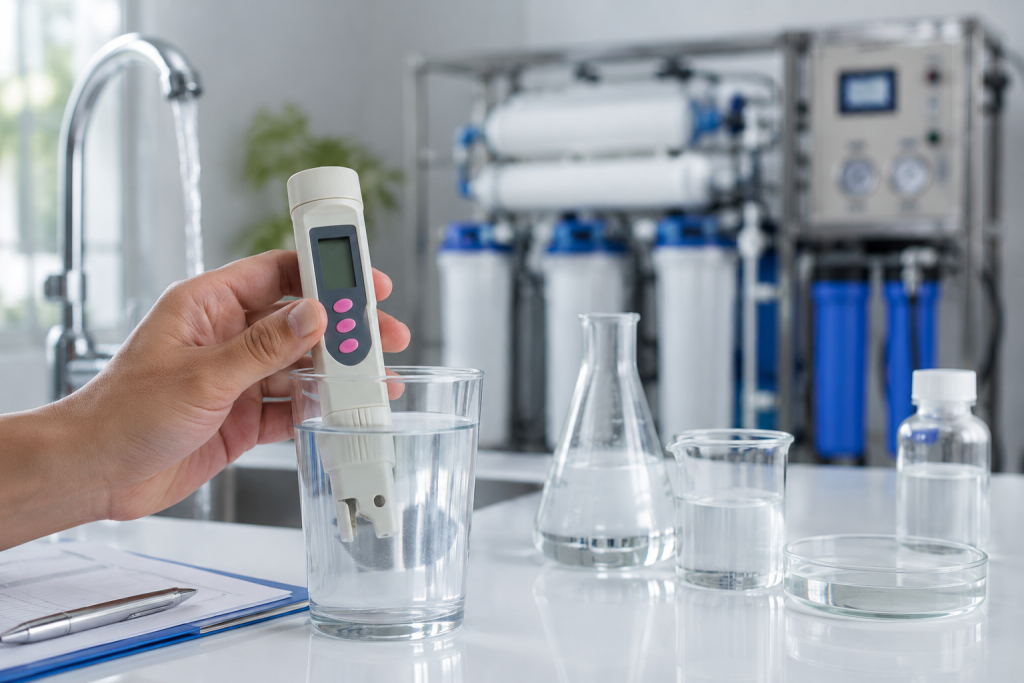
Handheld TDS meter. Quick and cheap. Dip it in a water sample and read the number. It measures electrical conductivity and converts it to ppm, so treat it as an estimate.
Lab testing. A proper lab test gives exact values and can check for specific contaminants like fluoride, arsenic, nitrates, and bacteria. If you’re setting up a plant or checking compliance, always go with a lab report.
Test more than once, too. Borewell TDS can change with season and water table levels.
How to Reduce TDS
The right method depends on how high the number is and what you need the water for.
Reverse Osmosis (RO). The most common choice. RO membranes remove 90 to 99 percent of dissolved solids. Good for drinking water and many industrial applications.
Demineralisation (DM plant). Ion exchange resins remove dissolved ions, producing very low TDS water for boilers and process use.
Mixed bed polishing. Takes DM water even lower, for high-pressure boilers and sensitive processes.
Blending. Some plants mix treated and untreated water to hit a target TDS. It works when the raw water is only slightly high.
Note that boiling water doesn’t reduce TDS. It actually concentrates it as water evaporates. Basic carbon filters and UV purifiers don’t reduce TDS either.
Choosing the Right Treatment
Ask yourself three questions:
- What’s my current TDS, tested properly?
- What’s the water for: drinking, boiler feed, process use, or cooling?
- What TDS does that application need?
If your borewell reads 250 ppm and you only want better drinking water, a simple filter may be enough. If it reads 1,500 ppm, you need RO. And if you’re feeding a boiler, you’re looking at DM or mixed bed treatment.
Final Thought
TDS is a useful number, but only if you understand what it can and can’t tell you. It shows how much is dissolved, not whether that stuff is harmful. Test your water properly, match the treatment to your actual use, and don’t chase a low number just because it sounds impressive. The best TDS level is the one that fits what you’re using the water for.
Keywords: TDS in water, safe TDS level in drinking water, what is TDS in water, TDS level for RO water, high TDS water problems, how to reduce TDS in water, BIS 10500 TDS limit, TDS meter reading, TDS water treatment plant, RO plant for high TDS water