
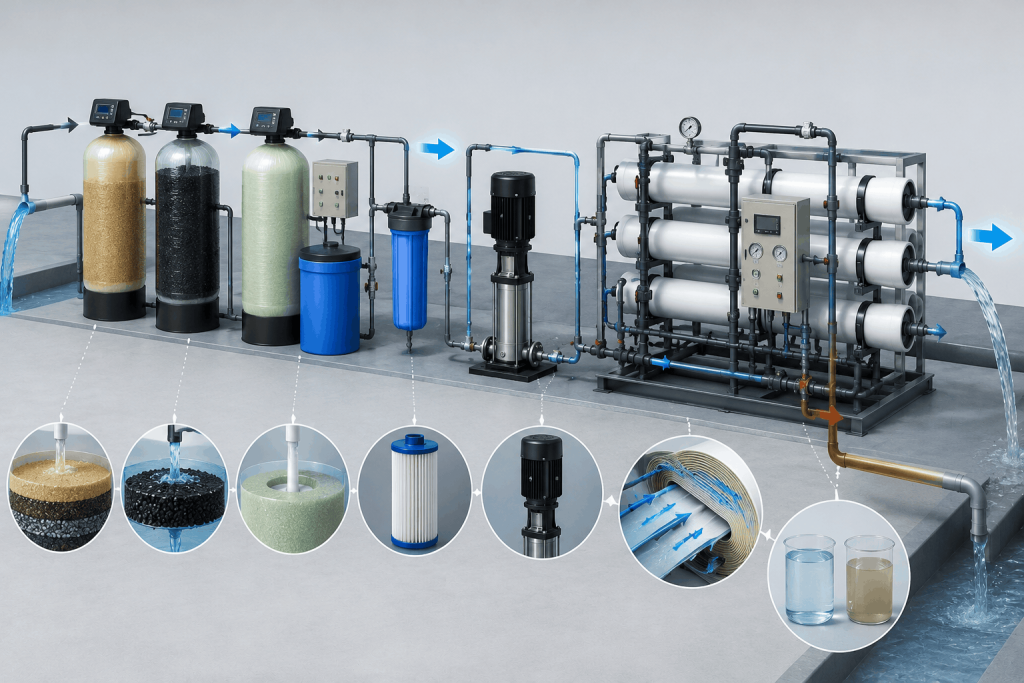
Most people know RO as “that purifier that makes water taste better.” Ask how it actually works, and the answer usually stops at “it has a membrane.”
That’s a fair start. But if you run a plant, buy one, or just want to understand what you’re paying for, the full process matters. Let’s walk through it, one step at a time.
What Is Reverse Osmosis?
Start with normal osmosis. When you separate salty water and fresh water with a very fine membrane, fresh water moves toward the salty side on its own. Nature tries to balance the two.
Reverse osmosis flips that. You push the salty water against the membrane with high pressure. Now the water moves the other way. Clean water passes through, and the salts, minerals, and most contaminants stay behind.
That’s the whole idea. The membrane works like an extremely fine filter, and the pump supplies the force.
Step 1: Raw Water Intake
Everything starts with the source. It might be a borewell, a municipal line, or a storage tank. The quality of this water decides how the rest of the plant gets designed.
Good plants test the raw water first. They check TDS, hardness, iron, chlorine, pH, and turbidity. Skip this, and you risk choosing the wrong membrane or pre-treatment later.
Step 2: Pre-Treatment
RO membranes are delicate. Dirt, chlorine, and hardness damage them fast. So the water goes through pre-treatment before it gets anywhere near the membrane.
A typical pre-treatment train includes:
- Pressure sand filter or multimedia filter. It removes suspended solids and turbidity.
- Activated carbon filter. It strips out chlorine and organic matter.
- Water softener. It removes hardness, so scale doesn’t build on the membrane.
- Antiscalant dosing. It stops scale-forming salts from settling as they concentrate.
Many operators say pre-treatment decides how long an RO plant lasts. It’s the least exciting stage, but it protects the most expensive part.
Step 3: Cartridge Filtration
Right before the membrane, the water passes through a cartridge filter. Most use a 5-micron rating. This acts as the final safety net.
It catches fine particles that slipped past earlier stages. It also protects the high-pressure pump from debris. Operators replace these cartridges regularly, since they clog over time.
Step 4: High-Pressure Pump
Now the water needs serious force. The high-pressure pump raises the pressure well above the water’s natural osmotic pressure.
How much pressure depends on the water. Brackish borewell water might need 10 to 20 bar. Seawater needs 50 to 70 bar. Higher TDS means higher pressure, and that means higher power cost.
Step 5: The RO Membrane
This is where the actual separation happens. Most industrial plants use spiral-wound thin film composite (TFC) membranes. Manufacturers roll layers of membrane sheet around a central tube, and the whole element sits inside a pressure vessel.
Pressurised water flows along the membrane surface. A portion passes through the membrane. That clean stream is called permeate. The rest carries the concentrated salts and leaves as reject (also called concentrate or brine).
A good membrane rejects 95 to 99 percent of dissolved salts. It also removes bacteria, many organic compounds, and a wide range of dissolved contaminants.
Step 6: Permeate and Reject Streams
Two streams leave the membrane:
- Permeate: the clean, low-TDS water you want
- Reject: the concentrated stream carrying salts and impurities
The ratio between them is called recovery. If 75 litres of permeate come out of every 100 litres of feed, recovery is 75 percent. Higher recovery saves water but raises scaling risk, so designers balance the two.
Some plants send the reject back to the feed side to improve recovery. Others treat it further or reuse it for non-critical jobs like washing or gardening.
Step 7: Post-Treatment
Permeate often needs a final touch before use. Common steps include:
- pH correction. RO water runs slightly acidic, so plants adjust it.
- Mineral addition. Drinking water systems may add back minerals for taste.
- UV or chlorine disinfection. This protects stored water from bacteria.
- Polishing. Pharma and electronics units often send RO water on to a mixed bed or EDI stage.
Step 8: Storage and Distribution
Finally, the treated water goes to a storage tank and then to the point of use. Clean storage matters here. A dirty tank can undo everything the plant just did.
What Keeps an RO Plant Healthy?
The process only works well if you look after it. A few habits make a real difference:
- Monitor pressure drop across the membrane. A rising drop signals fouling.
- Track permeate flow and TDS every day.
- Clean membranes on schedule using chemical cleaning (CIP).
- Replace cartridge filters and pre-treatment media on time.
- Never let the plant sit idle for long without flushing it.
Most membranes last three to five years with good care. Poor pre-treatment can cut that to a year or less.
Where Industries Use RO
- Drinking water for societies, hotels, and hospitals
- Boiler feed water (often ahead of DM or mixed bed plants)
- Pharmaceutical and food processing
- Textile and dyeing units
- Cooling tower makeup water
- Wastewater recycling and reuse
Final Thought
RO looks simple from the outside, but each stage protects the next. Pre-treatment shields the membrane, the pump supplies the pressure, and post-treatment gets the water ready for use. Skip one link, and the whole chain suffers. Understand the steps, test your raw water, and pay attention to pre-treatment. That’s how you get clean water and a membrane that lasts.
Keywords: reverse osmosis process, how RO plant works, RO process step by step, RO plant working principle, reverse osmosis membrane process, industrial RO plant process, RO pre-treatment stages, RO permeate and reject water, RO recovery rate, RO plant manufacturer in Gurgaon