
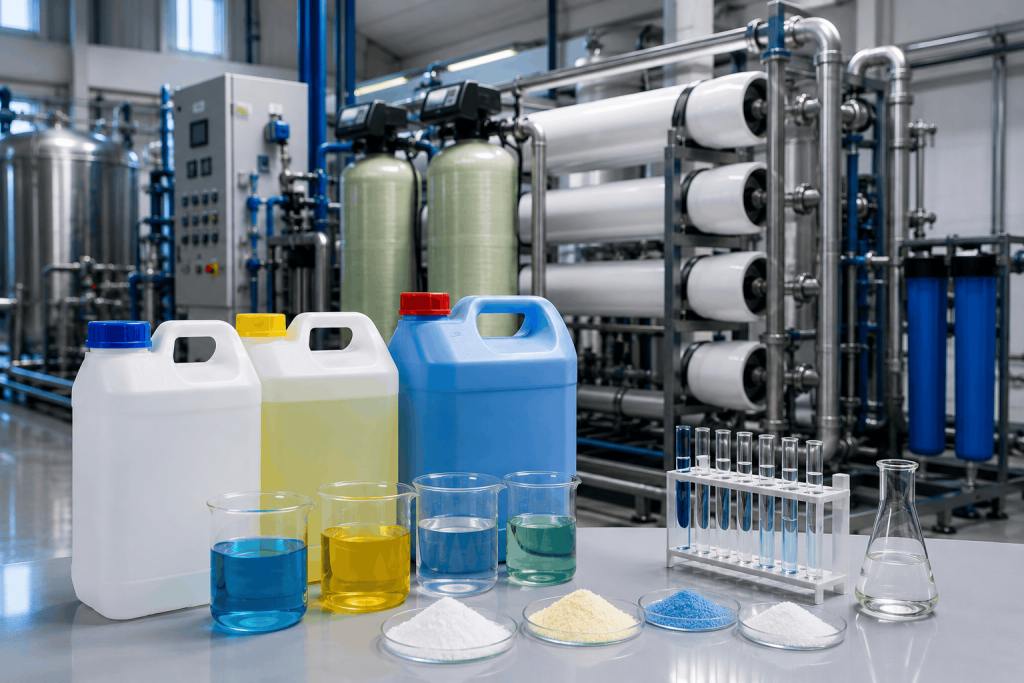
Most people notice water treatment chemicals only when something goes wrong. White scale chokes the pipes. The boiler tubes fail early. The cooling tower smells like a pond. By then, the repair bill is usually bigger than what a year of proper dosing would have cost.
This guide covers what these chemicals are, where each one is used, and what a plant actually spends on them every month. The numbers are rough ranges, but they are close to what Indian plants really see.
What Are Water Treatment Chemicals?
They are compounds added to water to fix a specific problem. The problem could be hardness, bacteria, corrosion, scaling, foaming, high turbidity or the wrong pH. Different systems have different problems, so no single chemical works everywhere. A boiler needs a very different program from a swimming pool.
Main Types of Water Treatment Chemicals
1. Coagulants and Flocculants
Small suspended particles don’t settle on their own. Coagulants like alum and PAC (poly aluminium chloride) neutralise the charge on those particles so they clump together. Flocculants, mostly polyelectrolytes, then bind the clumps into bigger flocs that sink.
Used in: raw water clarification, effluent treatment plants (ETP), sewage treatment plants (STP), textile and paper units.
2. Disinfectants and Biocides
These kill bacteria, algae and other microbes. Chlorine, sodium hypochlorite, calcium hypochlorite and chlorine dioxide are the common ones. In cooling towers, plants often use oxidising and non-oxidising biocides in rotation so microbes don’t build resistance.
Used in: drinking water, swimming pools, cooling towers, STP outlet water.
3. Antiscalants and Scale Inhibitors
Dissolved calcium, magnesium and silica turn into hard scale when water gets concentrated or heated. Antiscalants stop crystals from growing and sticking to surfaces. In RO plants, this one chemical protects expensive membranes.
Used in: RO systems, cooling towers, chillers, boilers.
4. Corrosion Inhibitors
Water slowly eats metal. Inhibitors such as phosphates, zinc compounds and azoles form a thin protective film on pipes and heat exchangers. Without them, a closed-loop chilled water system can start leaking within a few years.
Used in: cooling circuits, closed-loop systems, boilers.
5. pH Adjusters
Acids like HCl and sulphuric acid bring pH down. Caustic soda and soda ash push it up. Almost every other treatment works properly only inside a certain pH range, so this step matters more than it looks.
Used in: ETP, RO pre-treatment, neutralisation tanks, pools.
6. Oxygen Scavengers
Dissolved oxygen in boiler feed water causes pitting. Sodium sulphite and hydrazine substitutes remove it before it does damage.
Used in: boilers and steam systems.
7. Dechlorinators
Chlorine damages RO membranes. Sodium metabisulphite (SMBS) neutralises residual chlorine before the water reaches them.
Used in: RO pre-treatment.
8. Cleaning Chemicals for Membranes
Over time, RO membranes foul with scale, organics and biofilm. Acidic and alkaline cleaners restore flow and pressure. Skipping this is how membranes die at 18 months instead of 4 years.
Where Each Chemical Fits: Quick Reference
| System | Common chemicals |
|---|---|
| RO plant | Antiscalant, SMBS, membrane cleaners, softener salt |
| Cooling tower | Scale and corrosion inhibitor, biocides, acid for pH |
| Boiler | Oxygen scavenger, alkalinity builder, scale dispersant |
| ETP / STP | Coagulant, flocculant, hypochlorite, pH correctors |
| Swimming pool | Chlorine, pH adjusters, algaecide, clarifier |
Monthly Running Cost: What to Expect
Here is the part most blogs skip. These are approximate monthly chemical costs for typical small to mid-size setups in India. Your actual spend depends on water quality, hours of operation, supplier and dosing accuracy.
| Setup | Approx. monthly chemical cost |
|---|---|
| 1,000 LPH commercial RO plant | ₹2,000 to ₹5,000 |
| 100 TR cooling tower | ₹8,000 to ₹20,000 |
| 1 TPH boiler | ₹5,000 to ₹12,000 |
| 50 KLD STP | ₹3,000 to ₹8,000 |
| Medium swimming pool | ₹5,000 to ₹15,000 |
| 50 KLD ETP (industrial) | ₹15,000 to ₹40,000 |
A few things push these numbers up or down:
- Raw water TDS and hardness. Borewell water in Delhi NCR is hard, so scale control costs more here than in many other regions.
- Cycles of concentration. A cooling tower run at 5 cycles uses less make-up water and fewer chemicals than one run at 2.
- Dosing method. Manual dosing wastes chemicals. Automatic dosing pumps with a controller usually pay for themselves within a year.
- Product quality. A cheap antiscalant at half the price often needs double the dose.
The better way to look at it: chemical cost is usually a small slice of the total. Membrane replacement, boiler descaling, and unplanned shutdowns cost far more than the chemicals that prevent them.
How to Keep Chemical Costs Under Control
- Test your water first. Guessing the dose is the most expensive habit in this business.
- Dose by flow, not by feel. Metering pumps linked to flow or conductivity remove the guesswork.
- Log everything. Daily readings of pH, TDS and chemical consumption show problems early.
- Don’t mix suppliers randomly. Some chemicals react badly with each other.
- Store and handle properly. Acids, caustic and oxidisers should never share a storeroom.
Final Thoughts
Water treatment chemicals aren’t an optional extra. They are what keeps RO membranes, boilers, chillers and pipes working for their full life. The monthly cost looks like an expense, but in practice it works more like insurance.
The smartest move is to start with a proper water analysis, pick a program that suits your system, and review it every few months because water quality changes with the season. If you aren’t sure what your plant actually needs, a short consultation with a treatment specialist can save you from overdosing, underdosing, and the repair bills that follow.
Frequently Asked Questions
What is the most commonly used water treatment chemical?
Chlorine-based disinfectants and antiscalants are among the most widely used, depending on whether the system is for drinking water, RO or cooling.
How much does water treatment cost per month?
For small commercial systems it can be as low as ₹2,000 a month. For cooling towers or industrial ETPs it can reach ₹20,000 to ₹40,000 or more.
Can I reduce chemical use with better equipment?
Yes. Good pre-treatment, automatic dosing and proper blowdown control can cut consumption noticeably.
Are water treatment chemicals safe?
They are safe when handled and dosed correctly. Use gloves, goggles, proper ventilation and follow the supplier’s safety data sheet.
Keywords
water treatment chemicals, types of water treatment chemicals, water treatment chemicals cost, monthly running cost of water treatment, antiscalant for RO, cooling tower chemicals, boiler water treatment chemicals, ETP chemicals, STP chemicals, water treatment chemicals supplier India