
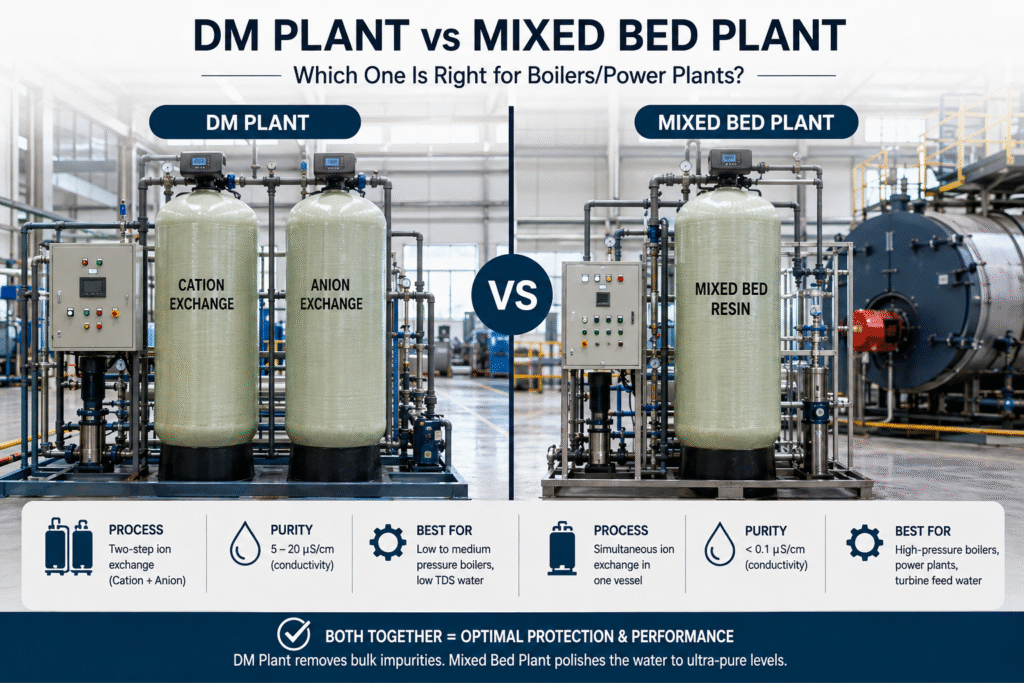
Setting up a boiler feed water system, or working on a power plant’s water line? At some point someone’s going to ask: do you need a DM Plant, a Mixed Bed Plant, or both? Vendors throw both terms around like they mean the same thing, and honestly, that mix-up is exactly why so many plants end up either overspending on equipment they don’t need, or underspending and dealing with water quality headaches a few months down the line.
So let’s actually sort this out. What does each system do, where do they differ, and which one fits your setup.
What Is a DM Plant?
A DM (Demineralization) Plant pulls dissolved minerals and salts out of water through ion exchange. It works in two separate stages.
First comes cation exchange. Water passes through a cation resin bed that grabs the positively charged ions — calcium, magnesium, sodium, and the like — and swaps them out for hydrogen ions.
Then anion exchange. The water moves into a separate anion bed, which strips out negatively charged ions such as chlorides, sulfates, and bicarbonates, replacing them with hydroxide ions.
Since the two resin types live in separate vessels, this happens in sequence rather than all at once. It gets you solid demineralization — usually bringing conductivity down somewhere in the 5–20 µS/cm range, though the exact number depends on your raw water and how the system’s built.
What Is a Mixed Bed Plant?
A Mixed Bed Plant does things differently. Instead of splitting cation and anion resins into two tanks, it mixes both types together in one vessel. Water flowing through that blended bed gets hit by both ion-exchange reactions at once, in the same space.
That simultaneous action is what makes Mixed Bed so effective. It can push conductivity down below 0.1 µS/cm — a massive step up in purity compared to what a DM Plant does on its own.
The Real Difference: It’s Not Either/Or
This is where people usually get tripped up. A Mixed Bed Plant isn’t there to replace a DM Plant — it’s a polishing stage that comes after one.
Picture it this way: the DM Plant does the heavy lifting, stripping out the bulk of dissolved salts from raw water. The Mixed Bed Plant then takes that already-treated water and cleans up whatever trace ions managed to slip through, getting conductivity down to near-zero levels.
So in most boiler and power plant setups, you won’t see one or the other — you’ll see both, working together, DM Plant first and Mixed Bed second.
When a DM Plant Alone Is Enough
If your boiler runs at low to medium pressure and you’re not chasing extremely strict feed water specs, a DM Plant on its own might do the job just fine. This tends to be true for:
- Small to mid-size industrial boilers
- Process steam applications where ultra-pure water isn’t essential
- Setups where the raw water is decent to begin with, so there’s less ion load to deal with
In these cases, adding a Mixed Bed Plant is often money spent on purity your boiler was never going to need.
When You Need the Mixed Bed Stage Too
High-pressure boilers and power plants are a different story. As pressure climbs, the amount of dissolved solids your feed water can tolerate drops fast. Even tiny amounts of leftover minerals start causing scale, deposits on turbine blades, or corrosion once you’re operating at high temperature and pressure.
You’ll generally want DM Plant plus Mixed Bed polishing in situations like:
- High-pressure boilers, roughly above 60 kg/cm²
- Power generation setups, especially where steam feeds a turbine directly
- Anywhere conductivity needs to stay consistently under 0.2 µS/cm
- Facilities where the boiler manufacturer’s warranty spells out strict water quality limits
Skipping the Mixed Bed stage here isn’t really a way to save money — it’s a reliability gamble. It tends to show up later as unplanned maintenance, shorter equipment life, or in the worst case, an unexpected shutdown.
Cost and Maintenance — How They Stack Up
A DM Plant costs less upfront and runs simpler. Regeneration is more straightforward too, since the cation and anion beds are handled separately — most plant operators can manage it in-house without much fuss.
A Mixed Bed Plant costs more to install and regeneration gets trickier, since separating the mixed resins (or sending them out for regeneration) takes more careful handling. But for applications that genuinely need that extra purity, it’s worth the trade-off.
Running both together naturally pushes up your total capital cost. For high-pressure systems though, that’s not really a choice — it’s what keeps your far more expensive boiler and turbine equipment from taking long-term damage.
A Quick Way to Decide
Ask yourself a few things:
- What pressure is your boiler operating at? Higher pressure means tighter water quality demands.
- Has the boiler manufacturer specified a max conductivity limit for feed water?
- Is your raw water source fairly clean, or is it carrying a heavy mineral load?
- Is this steam feeding a power turbine, or just going toward process heating?
If pressure’s on the lower side and requirements aren’t too tight, a DM Plant alone usually gets the job done. But if you’re dealing with high pressure, turbine-grade steam, or manufacturer specs that demand near-zero conductivity, plan for DM Plant plus Mixed Bed polishing right from the start — not as an afterthought once problems show up.
Final Thought
DM Plant vs Mixed Bed Plant isn’t really a competition between the two — it comes down to how pure your boiler or power plant actually needs its water to be. Get that wrong either way, and you pay for it: either through treatment capacity you never use, or through scaling, corrosion, and equipment failure you could’ve avoided. Match the treatment setup to your pressure rating and manufacturer specs, and you sidestep both problems.
Keywords: DM plant vs mixed bed plant, boiler feed water treatment, mixed bed plant for power plants, DM plant for boilers, ion exchange water treatment, boiler water demineralization, mixed bed polishing plant, high pressure boiler water treatment, DM plant power plant, water conductivity boiler feed