
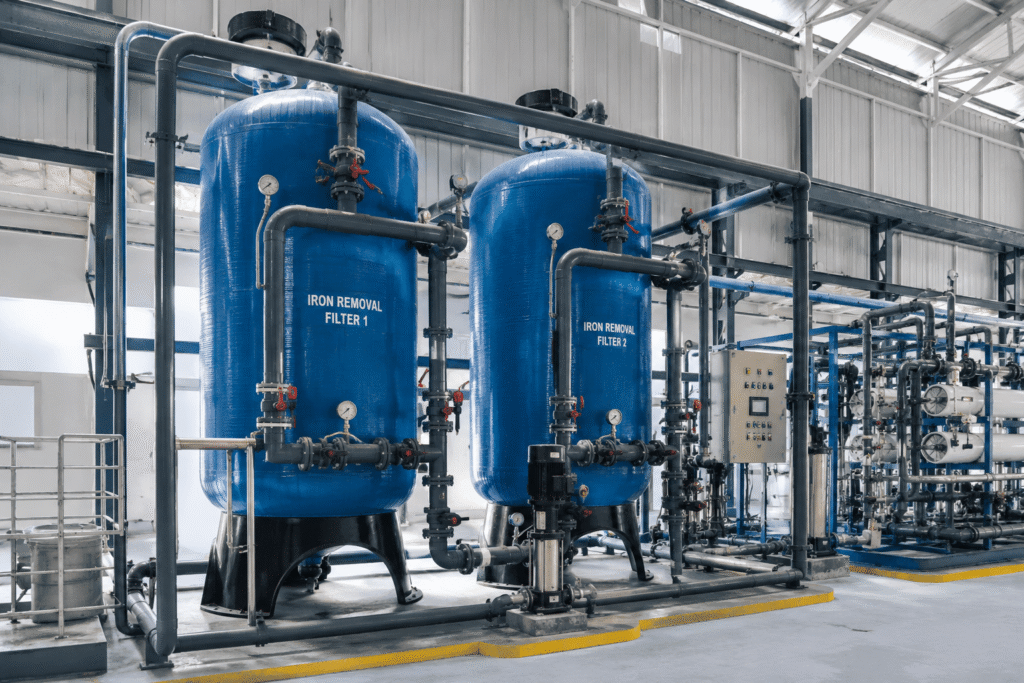
Ask anyone who manages a plant running on borewell or groundwater. There’s a good chance they have a story about the “iron problem.” Rust-coloured stains creep across equipment. Pipes narrow over time for no obvious reason. Water sometimes comes out with a faint orange tint. It rarely looks urgent at first. Then one day, maintenance costs jump. Someone finally traces it back to iron.
Where All That Iron Comes From
Groundwater naturally picks up dissolved iron. This happens as it moves through soil and rock, especially in regions where the water table sits close to iron-bearing deposits. In small doses, you’d probably never notice it. But industrial setups don’t use small doses. They pull water continuously, in bulk, for hours on end. Even a moderate iron level turns into a real problem once you multiply it across that kind of volume.
The moment that water meets air, the dissolved iron oxidizes. It turns into those reddish-brown particles most people recognize instantly. That’s the part you can see. What’s harder to notice, at least early on, is what it’s doing inside your pipes and machinery the whole time.
Most Plants Don’t Notice Until Something Breaks
Honestly, a lot of facilities ignore iron content until a pump fails. Or until a boiler starts underperforming. By then, the damage has usually spread across multiple systems. Pipes and valves slowly narrow as deposits build along their inner walls. Boilers and cooling towers lose efficiency because of scale. In food processing or pharma units, iron contamination can compromise entire batches. Textile, paper, and beverage manufacturers face a different headache. Discoloured water starts showing up in the finished product itself.
None of this happens overnight. That’s exactly why it gets ignored for so long. It’s a slow creep, not a sudden failure.
So What Do Iron Removal Filters Actually Do
Strip it down to basics. These filters work in one of two ways. They either oxidize the dissolved iron into a solid form so a filter can trap it. Or they chemically bind the iron so it filters out before reaching downstream equipment. Plants choose a method based on the water source and how much iron they’re dealing with.
Oxidation-based filtration uses air, chlorine, or potassium permanganate. This converts dissolved iron into particles. A media bed then catches those particles — manganese greensand and birm are common choices here. Ion exchange works a bit differently and suits lower iron levels. It swaps iron ions for sodium ions, the same basic principle behind a household water softener. Then there’s aeration followed by sand filtration. This is probably the simplest and most budget-friendly route. Water gets exposed to air so the iron oxidizes. Then it runs through a sand bed that catches the solids.
Which method makes sense depends on a few things. How much iron is present. Whether manganese shows up too. And what that water gets used for downstream.
Scale Changes Everything Here
A home filter deals with a few hundred litres a day, maybe less. An industrial system could push tens of thousands of litres continuously into boilers, cooling loops, or production lines. These lines genuinely cannot afford unexpected downtime. That difference alone changes how engineers size the filter. It changes how often the media needs replacing. It also changes how frequently backwashing has to happen. You can’t really eyeball this stuff at industrial scale. Engineers have to plan it around actual usage, not rough guesses.
Plants often pair iron removal with a pre-treatment step too, like sediment filtration. Larger particles tend to clog the iron media faster than people expect. That shortens its usable life considerably.
What Changes Once Iron Is Actually Filtered Out
Once a plant sorts this out, the improvements usually go beyond cleaner-looking water. Equipment tends to last longer. Energy use in boilers and heat exchangers drops, since scale stops building up as quickly. And in industries where water quality directly touches the final product — dyeing units, breweries, pharma manufacturing — output consistency noticeably improves too.
This change doesn’t look particularly dramatic in a report. But it quietly affects nearly every part of the operation once it’s running.
Final Thought
Iron in water can seem almost cosmetic at first — just a slight tint, nothing alarming. But in an industrial setting, it rarely stays that small for long. A well-designed iron removal system does more than make water look clearer. It protects equipment. It keeps maintenance bills down. It makes sure production doesn’t grind to a halt over something preventable. For any facility running on groundwater, this isn’t a nice-to-have upgrade. It’s closer to insurance for the whole operation.
Keywords: iron removal filters, industrial water treatment, iron removal in water, oxidation filtration systems, industrial water quality, manganese greensand filter, ion exchange iron removal, aeration filtration system, boiler water treatment, groundwater iron removal