
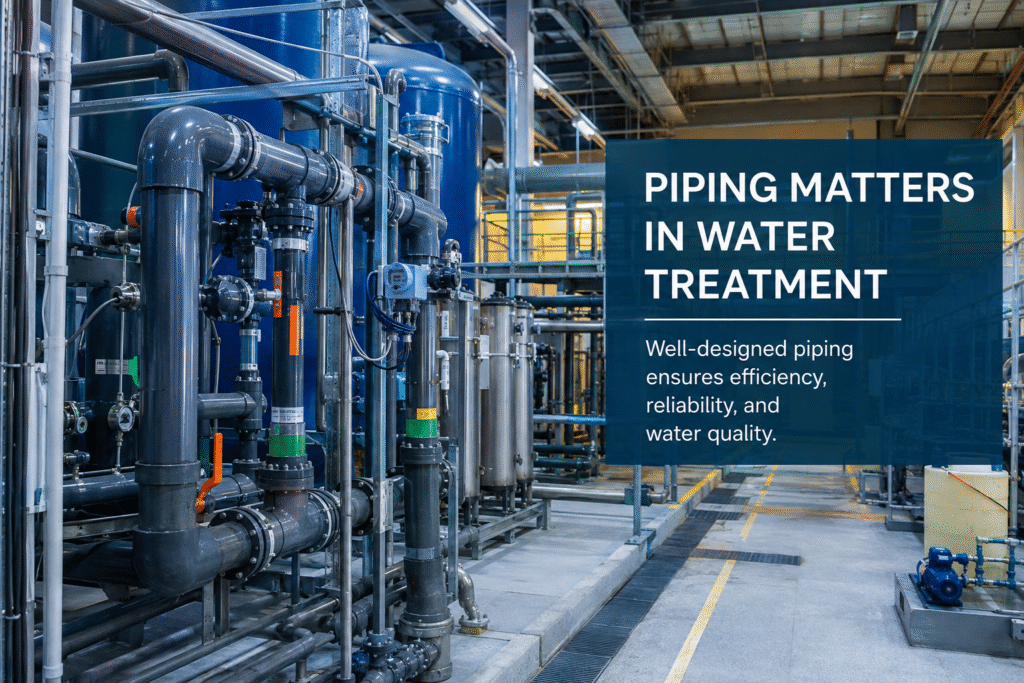
Ask most people what makes a water treatment plant work, and they’ll talk about filtration systems, chemical dosing, maybe the membranes if they’ve done a bit of reading. Piping? Almost nobody mentions it. And yet a plant can own top-of-the-line equipment and still underperform. Why? Because the pipe network moving water between all those components was never designed properly in the first place.
It’s easy to overlook. Pipes just sit there, right? They don’t have moving parts. They don’t need calibration. Nobody schedules a photoshoot around them. But the layout, sizing, and material choices behind a piping system quietly decide whether the rest of the plant can even do its job.
Here’s a closer look at what actually goes wrong.
Flow Rates Drift, and Everything Downstream Feels It
Treatment processes rely on specific flow assumptions. Coagulation needs a certain mixing intensity. Disinfection needs a minimum contact time. Filtration needs water moving at a rate the media can actually handle. All of that math falls apart the moment pipe sizing doesn’t match reality.
Undersized pipes push water through too fast. Contact time in a disinfection chamber can drop below what’s needed to kill pathogens reliably. That’s not a small issue when you’re talking about drinking water. Oversized pipes cause the opposite problem: water moves too slowly, and sediment starts settling somewhere it shouldn’t. Now you’ve got buildup nobody planned for.
Bad routing makes things worse. Every unnecessary elbow or bend adds turbulence and resistance the original design never accounted for.
Dead Legs Are a Bigger Deal Than They Sound
Engineers use the term “dead leg” for a pipe section where water barely moves, or doesn’t move at all. Old connections that were never capped, valves in awkward spots, tees that lead nowhere useful anymore — these create pockets where water just sits.
That stagnation isn’t cosmetic. It’s a real biofilm risk. Bacteria love slow-moving, low-oxygen environments. Once biofilm establishes itself in a dead leg, it can reintroduce contamination further down the line and undo work the treatment process already did.
A good design avoids these dead-end sections almost by instinct. A rushed one accumulates them, usually without anyone noticing until a water quality test flags something odd.
Pressure Loss Quietly Drains Your Energy Budget
Every bend, valve, and diameter change costs you pressure. That’s just physics — you never get rid of it entirely. But when a piping layout is genuinely inefficient, pumps end up compensating for resistance that shouldn’t exist in the first place.
That compensation isn’t free. It shows up as higher energy bills and more wear on pump seals and motors. Equipment starts needing replacement sooner than it should. Most plants don’t catch this until someone compares pump performance against the original design specs. Honestly, the gap is usually bigger than anyone expected.
The Wrong Pipe Material Can Undo Everything Downstream
Layout gets most of the attention, but material selection matters just as much. Say corrosive water runs through pipes that weren’t rated for it. The pipe itself starts breaking down from the inside.
That means metals, particulates, or corrosion byproducts leach into water that’s supposed to be getting cleaner as it moves through the system, not dirtier. This kind of problem doesn’t announce itself either. It builds up slowly, over months or years, until someone finally traces an unexplained water quality issue back to corrosion sitting quietly in the pipe walls the entire time.
Maintenance Turns Into a Constant Fight
Piping mistakes don’t just hurt performance while the plant runs. They make every future repair harder too. Pipes crammed into inaccessible spaces turn a five-minute fix into a half-day job. Isolation valves placed in the wrong locations mean shutting down more of the system than necessary just to service one section.
Over time, this stacks up into more downtime and higher labor costs. Worse, the maintenance crew spends half its energy working around the layout instead of actually solving problems.
None of This Is Hard to Prevent
What makes all this frustrating is simple: piping problems are almost always avoidable. Proper hydraulic modeling helps. So does correct sizing, and routing that minimizes dead legs. Materials should get chosen based on real water chemistry, not just whatever’s cheapest or easiest to source. None of this counts as exotic engineering. It’s standard practice that sometimes gets rushed or trimmed to save time and money during design or construction.
The trouble is, those savings rarely stay saved. A shortcut taken during construction tends to resurface later as reduced efficiency and higher operating costs. Water quality risks follow too — risks that a bit more planning upfront could’ve avoided entirely.
So if there’s one thing worth taking away here, it’s this: piping isn’t the boring part of a water treatment plant that nobody needs to think about. It’s one of the most consequential design decisions in the whole system, and it deserves just as much attention as the equipment everyone actually likes talking about.