
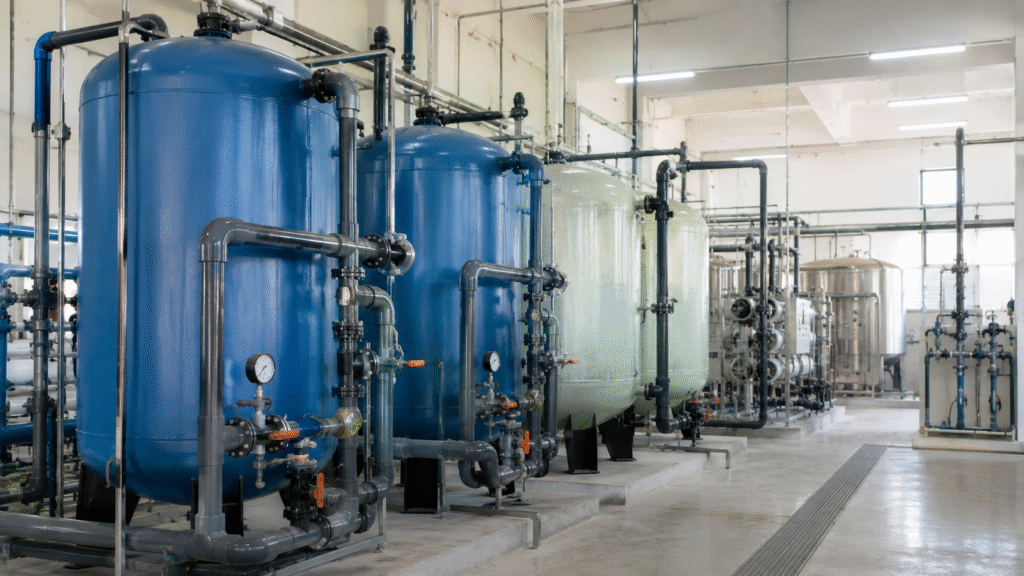
Ask five different water treatment operators which filter they trust more, and you’ll probably get five different answers. That’s not a cop-out — it’s just true. Sand filters and multimedia filters both do the same basic job on paper. They remove suspended solids before water moves on to the next stage. But how they get there, and how well they hold up under certain water conditions, isn’t really the same thing. If you’re setting up or upgrading a system, that gap matters more than people expect going in.
What a Sand Filter Actually Does
A sand filter does pretty much what the name suggests. Water passes through a bed of sand, and as it moves down, particles get trapped along the way. It’s old, it’s simple, and honestly, that’s kind of the point — this method has been around for decades because it just works for a lot of situations.
It handles moderate turbidity fine. Installation is straightforward, cost stays low, and once your team gets the hang of backwashing, maintenance isn’t much of a headache either. For smaller systems, or places where water quality doesn’t swing wildly from one week to the next, a sand filter usually gets the job done without a lot of drama.
Where it struggles is consistency under pressure — literally. Since it’s a single layer of media, most of the filtering happens near the surface. Once that top layer fills up with particles, flow slows down fast and pressure drop climbs quicker than anyone would like. Feed water with heavy or inconsistent solid loads exposes this weak point pretty quickly.
Where Multimedia Filters Pull Ahead
Multimedia filters take the same core idea and stack more onto it. A typical setup runs anthracite on top, sand in the middle, and sometimes garnet or something similarly dense at the bottom. Each layer has a different particle size, so filtration doesn’t just happen at the surface — it happens through the entire bed.
That layering is really the whole advantage. Water hits the coarser media first, which grabs the bigger particles early, then works down through finer layers that catch what’s left. You end up with better overall filtration and noticeably longer stretches between backwash cycles.
If your water quality bounces around a lot, or your feed water carries a heavier solid load, multimedia filters tend to outperform sand filters by a fair margin. Not always dramatically, but enough that operators notice over time.
How They Actually Compare in Practice
Turbidity removal tends to go to multimedia filters. The layered design just covers a wider range of particle sizes, so it handles spikes better than a single-media setup can.
Flow rate holds up longer with multimedia too, mostly because particles spread across multiple layers instead of clogging near the top. That means fewer backwash cycles and steadier output.
Cost is where sand filters win, at least upfront. Cheaper media, cheaper installation — if your budget’s tight and your water stays fairly consistent, that lower entry price is a real factor, not something to brush off.
Maintenance also leans slightly toward sand filters. Fewer layers, fewer variables to track during backwashing, and troubleshooting stays a bit simpler when something’s off.
Long-term efficiency, though? That usually goes to multimedia. Longer run times and cleaner filtration can make up for the higher upfront cost over time, especially for systems that run constantly or deal with source water that keeps shifting.
So Which One Do You Actually Pick?
It comes down to what your water looks like and what your system realistically needs day to day. If your feed water stays clean and predictable and your budget’s tighter than you’d like, a sand filter will do the job without overcomplicating anything.
If your water quality swings, carries higher turbidity, or your system just can’t afford constant downtime for backwashing, spend the extra money on a multimedia filter. It tends to pay for itself over time through better efficiency and fewer maintenance headaches, especially in bigger or more demanding setups.
One thing worth doing regardless — test your actual water before deciding anything. Guessing based on general assumptions about your source is how people end up with the wrong filter installed for two years before anyone notices.
Final Thoughts
Neither filter type wins this outright, and honestly, it was never really a competition. They solve different problems for different situations. Sand filters bring simplicity and lower cost to systems with stable water quality. Multimedia filters bring better performance to systems dealing with tougher, more unpredictable conditions. The right call depends on your water source, your budget, and how much downtime you can realistically live with. Test the water first, understand what your system actually needs, and the decision usually turns out simpler than it seemed at the start.
Keywords: sand filters vs multimedia filters, water filtration system, multimedia filter for water treatment, sand filter water system, turbidity removal filters, water treatment filtration methods, backwash filter system, water filter media comparison, industrial water filtration, best filter for water system