
Ask three STP vendors which technology you should buy, and you’ll probably get three different answers. One pushes MBBR. Another swears by SBR. The third says only MBR will do.
They aren’t necessarily lying. In fact, each technology works well in the right place. The trouble starts when you pick one without knowing how they differ. So let’s compare them in plain terms, and show you how to choose.
A Quick Look at Each Technology
MBBR (Moving Bed Biofilm Reactor)
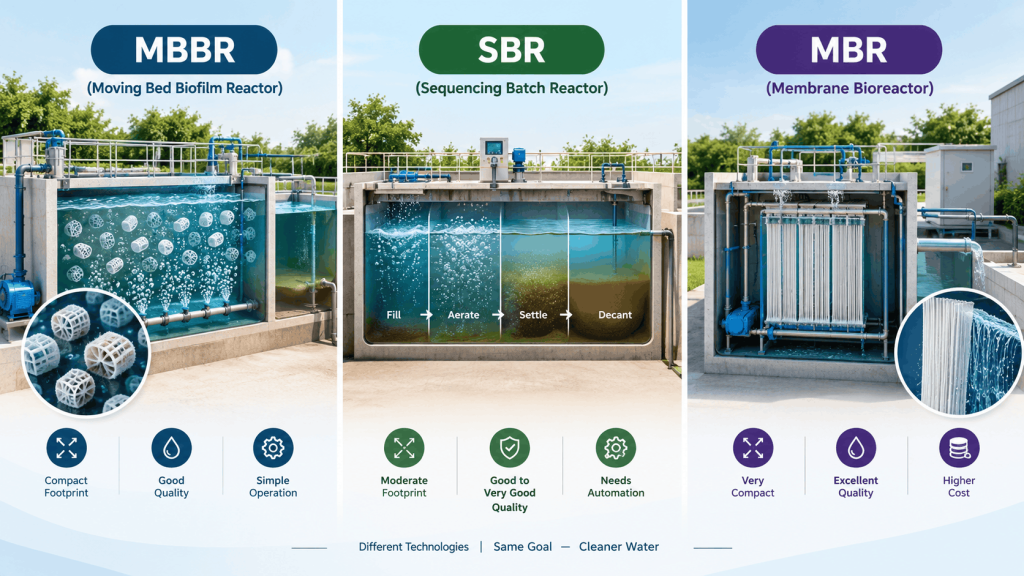
An MBBR tank holds thousands of small plastic carriers that float freely in the water. Bacteria grow as a thin film on these carriers. At the same time, air from a blower keeps them moving and supplies oxygen. The film breaks down the waste, then a clarifier settles out what’s left.
Because the bacteria live on the carriers, the plant holds a lot of biomass in a small tank.
SBR (Sequencing Batch Reactor)
An SBR does everything in one tank, one step after another. The tank fills, then it aerates, then the solids settle, and finally the clear water gets drawn off. Then the cycle starts again. There’s no separate clarifier, because the same tank does the settling.
Controls and timers run the sequence, so automation matters a lot here.
MBR (Membrane Bioreactor)
An MBR combines biological treatment with membrane filtration. Instead of a clarifier, fine membranes sit in the tank or beside it. They hold back solids and bacteria and let clean water pass through.
The result is very high-quality treated water in a compact setup.
Side-by-Side Comparison
| Factor | MBBR | SBR | MBR |
|---|---|---|---|
| Footprint | Compact | Moderate | Very compact |
| Treated water quality | Good | Good to very good | Excellent |
| Capital cost | Moderate | Moderate | Highest |
| Running cost | Moderate | Moderate | Higher (power, membrane care) |
| Operation | Simple | Needs good automation | Needs skilled operation |
| Handles load variation | Well | Fairly well | Well |
| Best for reuse | Often needs filtration after | With filtration | Often directly suitable |
Treat the table as a rough guide. However, real performance depends on design and operation.
Where Each One Fits Best
Choose MBBR When:
- Space is tight, but you don’t need the very highest quality
- The load changes through the day, like a hotel or a residential society
- You want reliable, simple operation with modest staff skills
- You plan to upgrade a crowded older plant without building a new tank
Choose SBR When:
- You have the space for a reactor tank, but want to skip a separate clarifier
- Flow comes in batches or varies widely, such as institutions and some industries
- You have good automation and a trained operator
- You want a flexible plant that can handle changing conditions
Choose MBR When:
- Land is very expensive, and every square metre counts
- You need top-quality treated water for reuse, like flushing, cooling, or landscaping
- Discharge rules are strict
- Your budget covers higher capital and running cost
How Day-to-Day Operation Differs
A plant looks very different on paper than it does at six in the morning when something trips. Here’s what operators actually deal with.
MBBR is the most forgiving. The carriers hold the bacteria, so a short power cut or a sudden load change doesn’t wipe out the biology. For example, operators mainly watch the blower, the carrier levels, and the clarifier. Also, sludge handling is routine.
SBR depends on its sequence. If a valve sticks, a decanter jams, or the timer drifts, the whole cycle suffers. For this reason, the plant needs reliable instruments and a trained person who understands the cycle. Once tuned, it runs smoothly and uses less equipment.
MBR asks for the most attention. Membranes need regular cleaning, and fouling can creep up if the pre-screening is poor. Fine screens at the inlet are a must, because hair, plastic, and grit damage membranes. In return, the plant gives you very clear water.
Sludge and Power Use
Every STP makes sludge, and every STP uses power. However, the pattern differs slightly between technologies.
- Sludge: MBBR and SBR produce moderate sludge. MBR can run with a higher biomass concentration, so it often makes a little less sludge, but it still needs proper dewatering and disposal.
- Power: Blowers use most of the electricity in all three. MBR adds power for membrane scouring and suction pumps, so its running cost per cubic metre is usually the highest.
If your electricity bill is a concern, ask each vendor for the expected power use per KLD, not just the motor ratings.
What About Cost?
MBBR and SBR sit close together in cost, and MBR usually costs the most. But the sticker price misleads. Look at the full picture:
- Capital cost: Equipment, tanks, and installation.
- Power: Blowers and, for MBR, extra pumping and membrane scouring.
- Chemicals and consumables: Membrane cleaning, media top-up, and disinfection.
- Manpower: Skilled operators cost more.
- Replacement: MBR membranes need replacing every several years.
Otherwise, a cheaper plant that fails to meet your discharge or reuse targets will cost more in the end.
Treated Water Quality and Reuse
Of course, your goal for the treated water matters as much as the technology.
If you only need to meet the discharge norms, MBBR or SBR with a clarifier and disinfection usually does the job. If you want to reuse the water for flushing, gardening, or cooling tower make-up, you’ll often add a pressure sand filter and an activated carbon filter after the biological stage. That polishing step brings clarity up and removes smell.
On the other hand, MBR already removes suspended solids, so its output often suits reuse with just disinfection. Even then, many sites add carbon filtration for colour and odour. Always check what quality your intended use really demands, and confirm that the design meets your local pollution control board’s conditions.
Questions to Ask Before You Decide
- How much space can I give the plant?
- What quality must the treated water reach?
- Will I reuse the water, and for what?
- How much does my daily flow vary?
- Who will operate the plant, and how skilled are they?
- What is my budget for both purchase and running costs?
- What does my pollution control board require?
Write your answers down before you talk to vendors. That way, they’ll make your conversations far more useful.
Common Mistakes
- Choosing MBR just because it sounds advanced, when a simpler system would do
- Picking the cheapest option without checking the discharge standard
- Ignoring the operator’s skill level
- Forgetting future expansion
- Skipping the raw sewage analysis
Final Thought
There’s no single best STP technology, only the best fit for your site. In short, MBBR suits compact, steady, low-fuss plants. SBR gives flexibility if you’ve got space and automation. Meanwhile, MBR delivers the cleanest water where land and rules are tight. So be clear about space, water quality, budget, and operator skill, and the right choice usually becomes obvious.
Keywords: MBBR vs SBR vs MBR, STP technology comparison, MBBR STP plant, SBR sewage treatment plant, MBR sewage treatment plant, best STP technology, STP plant types, sewage treatment plant selection, STP manufacturer in Gurgaon, STP plant for society