
Do you run a factory in a “high pollution” category — textiles, tanneries, distilleries, pharma, or chemicals? You’ve probably heard the term ZLD before. People usually mention it along with words like “mandatory” and “CPCB.” For most factory owners, that’s where the understanding stops.
Let’s break it down properly. What is ZLD? Why does it exist? How does it work, step by step? And what does it actually mean for your factory?
What Is Zero Liquid Discharge, Really?
Zero Liquid Discharge does exactly what the name says. No liquid effluent leaves your factory. A regular treatment plant cleans water to a “safe enough to discharge” level and releases it into a drain or river. A ZLD system works differently. It treats the water, recovers almost all of it for reuse, and converts the rest into solid waste.
In simple terms: no liquid goes out. Wastewater either returns to your process as reusable water, or leaves as dry solid residue.
Why Is This Even Necessary?
Many factory owners think a regular ETP is enough. For many industries, it is. But some sectors create a bigger problem. Textile dyeing, tanneries, and distilleries generate wastewater with very high TDS, high COD, or heavy salt content. Standard treatment can’t fully clean this water. Even “treated” water from these industries can still carry enough pollutants to damage rivers, groundwater, and soil over time.
ZLD closes this gap. Regulators pushed for it in industries where normal discharge norms weren’t working. Groundwater depletion and contamination had already become serious problems in some areas. Tamil Nadu and Gujarat’s textile clusters are common examples of where this happened.
Is ZLD Actually Mandatory?
Yes, for specific categories. The Central Pollution Control Board made ZLD compulsory for certain highly polluting sectors. This includes textile processing (dyeing and bleaching), tanneries, distilleries, and a few other high-TDS, high-salt industries. If your factory falls under one of these categories, ZLD isn’t optional. It’s tied directly to your consent to operate.
Plenty of factories outside the mandated list adopt ZLD voluntarily too. Two reasons drive this. First, water security matters more each year as freshwater access becomes less reliable. Second, export buyers increasingly demand sustainability compliance across their supply chain.
How a ZLD System Actually Works
Most explanations get either too technical or too vague. Here’s the process broken into stages that make sense.
1. Pre-Treatment
Wastewater first passes through filtration. This step removes large particles, oils, and suspended solids. It clears out the rough material before sensitive equipment handles the water downstream.
2. Membrane Filtration (RO/UF)
Reverse osmosis or ultrafiltration separates clean water from water carrying dissolved salts and contaminants. This stage recovers most of your reusable water.
3. Evaporation
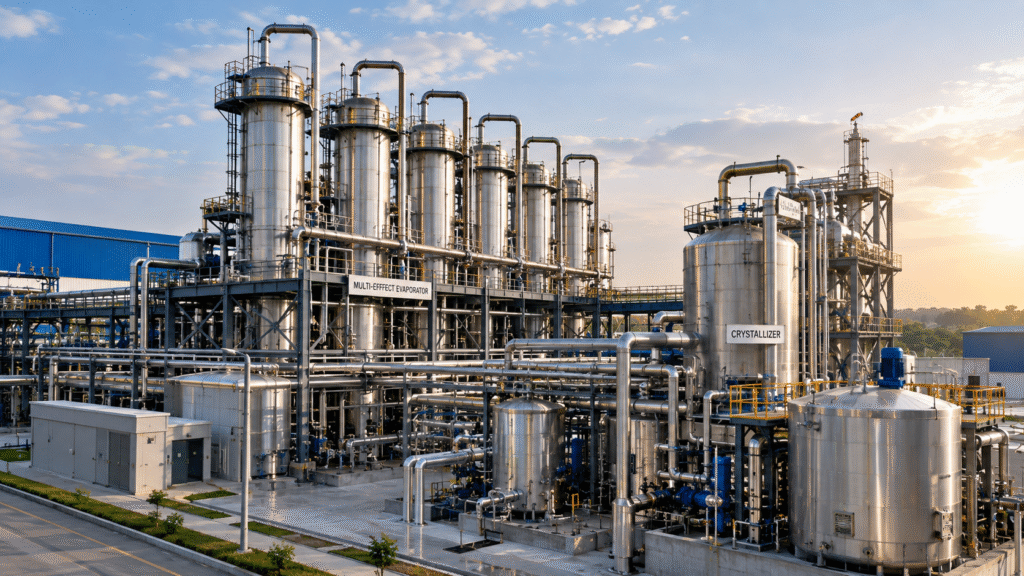
The leftover concentrated water, called brine, goes through thermal evaporators. These machines concentrate the brine further and pull out more water vapor. The system condenses this vapor and recovers it as usable water.
4. Crystallization
The remaining material after evaporation crystallizes into solid salts and residues. This is the “zero liquid” part of the process. The waste is now solid, not liquid. You can dispose of it properly, or in some industries, sell or reuse it.
5. Water Recovery
A well-designed ZLD system typically recovers 90–99% of the original water. The exact number depends on your technology mix and effluent characteristics. Your factory sends this recovered water straight back into cooling, washing, or wherever the process needs it.
What This Means for Your Factory, Practically
- Compliance certainty: If you’re in a mandated sector, a ZLD system keeps your consent-to-operate valid. It also keeps inspections from turning into penalties.
- Lower freshwater dependency: Recovering 90%+ of your process water matters in water-stressed regions. NCR and North India have been trending in that direction.
- Higher upfront and running cost: ZLD systems cost significantly more to install and run than standard ETP/STP setups. The evaporation stage drives most of this extra cost through energy consumption.
- Byproduct handling: The recovered solid salts need proper disposal. Some industries can sell these salts onward, which is worth factoring into your operating economics.
- Long-term water security: Factories that depend heavily on groundwater or municipal supply reduce their risk of disruption from water shortages.
Common Misconception: ZLD Isn’t Just “A Bigger ETP”
This trips up a lot of people. An ETP treats wastewater to a dischargeable standard and releases it. A ZLD system follows a completely different design philosophy. It’s built around recovery and closed-loop reuse, not discharge. You can’t simply “upgrade” an existing ETP into a ZLD plant. The upgrade usually requires adding evaporation and crystallization stages on top of your existing treatment train, engineered specifically for your effluent’s salt and TDS load.
Final Thought
ZLD isn’t just a compliance checkbox anymore. Water-intensive, high-pollution industries are treating it as the baseline expectation now. This pressure comes from regulators, export buyers, and the simple reality of shrinking freshwater access. Yes, it costs more to install and run than conventional treatment. But if your factory sits in a mandated sector, or in a water-stressed region, the real question isn’t “should we install ZLD.” It’s “when.” Getting the right technology mix, matched to your specific effluent characteristics, determines whether ZLD becomes a manageable operating cost or an oversized one.
Keywords: Zero Liquid Discharge system India, ZLD plant for factories, ZLD system explained, CPCB ZLD compliance, zero liquid discharge industrial wastewater, ZLD system process, ZLD plant cost India, mandatory ZLD industries, ZLD vs ETP, industrial water recycling ZLD