
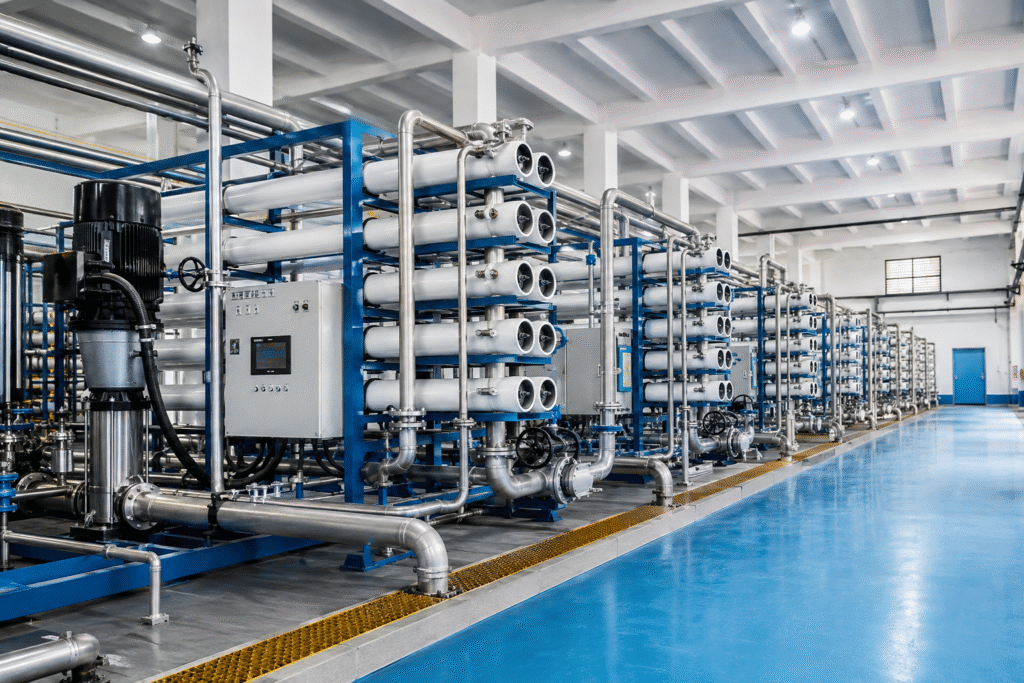
Ask most people what makes an industrial RO plant work well, and they’ll talk about membranes. Fair enough — membranes get all the attention. They’re the part everyone photographs, the part vendors love showing off in brochures. But talk to anyone who’s actually run a reverse osmosis plant for a few years, and they’ll tell you something different. The membranes aren’t really where the plant succeeds or fails. Pre-treatment is.
It doesn’t get the same spotlight, sure. Nobody puts “pre-treatment stage” on a marketing poster. But skip it, or half-do it, and you’ll watch an expensive RO system degrade in months instead of years.
What Pre-Treatment Actually Does
Raw water — whether it’s coming from a borewell, a river, or a municipal supply — carries a lot of stuff RO membranes were never built to handle. Suspended solids, silica, hardness ions, organic matter, sometimes chlorine, sometimes bacteria. None of that plays nice with a semi-permeable membrane that’s designed to filter at the molecular level.
Pre-treatment in an industrial RO plant exists to strip most of that out before water ever touches the membrane. Think of it as damage control that happens before any damage occurs. Multimedia filtration handles suspended solids. Softening or antiscalant dosing deals with hardness and scaling risk. Activated carbon filtration takes care of chlorine and organics. Cartridge filters catch whatever slips through everything before.
Every one of these steps exists because RO membranes are expensive and, frankly, kind of delicate.
Why Skipping This Backfires So Badly
Here’s the thing people underestimate — RO membrane damage isn’t usually sudden. It’s slow. It creeps up. Fouling builds layer by layer, scaling deposits accumulate over weeks, and by the time someone notices reduced flow or rising pressure, real damage has already happened.
A few things that go wrong without proper pre-treatment:
- Suspended particles clog membrane surfaces and reduce flux over time
- Hardness minerals like calcium and magnesium form scale that’s brutal to remove later
- Chlorine, if it reaches the membrane, breaks down polyamide layers permanently
- Organic fouling creates a film that microorganisms love to grow on
- Pressure requirements climb steadily, which pushes energy costs up too
None of this happens overnight, and that’s exactly what makes it dangerous. Plants run fine for months, sometimes over a year, before operators realize the membranes are quietly wearing out way ahead of schedule. By then, replacement costs have already piled up.
The Real Cost Math Nobody Talks About
RO membranes for industrial-scale plants aren’t cheap. Replacing them early, because pre-treatment wasn’t dialed in properly, ends up costing far more than doing pre-treatment right from day one would’ve.
There’s also downtime to factor in. Every time a plant has to shut down for membrane cleaning or replacement, that’s lost production. For industries running continuous processes — pharma, food and beverage, power generation — unplanned downtime hurts a lot more than the membrane cost itself.
Good pre-treatment isn’t really an added expense. It’s more like an insurance policy that happens to also improve day-to-day performance.
What Good Pre-Treatment Actually Looks Like
There’s no single formula here — it genuinely depends on the water source. A borewell with high hardness needs a different setup than surface water with heavy organic load. That said, a solid industrial RO plant pre-treatment system usually includes some combination of:
- Multimedia or sand filtration for suspended solids
- Water softening or antiscalant dosing to control scaling
- Activated carbon filtration for chlorine removal and organics
- Micron cartridge filtration as a final safety net before the membranes
- Regular water testing to catch shifts in source water quality early
Getting this combination right takes proper water analysis upfront. It’s not something you guess at or copy from another plant’s setup, because water chemistry varies enough site to site that a generic template rarely works well.
Bottom Line
Membranes might be the part everyone talks about, but pre-treatment is what actually decides whether an industrial RO plant runs smoothly for a decade or limps along needing constant repairs. It’s the unglamorous stage that quietly protects the expensive equipment everyone cares about.
If you’re setting up or upgrading an RO plant, don’t treat pre-treatment as a checkbox. Get the water tested, design the system around your actual source water, and the membranes — and your maintenance budget — will thank you for years.
Need help designing the right pre-treatment setup for your RO plant? Get your water tested and talk to an expert before you finalize the system.