
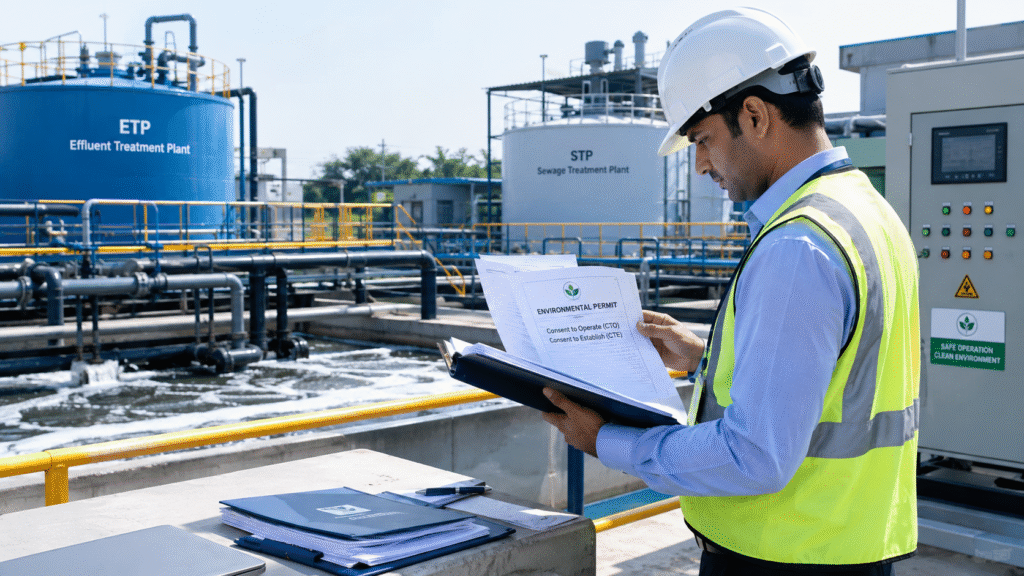
Most factory owners only think about Pollution Control Board compliance in two situations. First, when they’re setting up a new unit and someone tells them they need a “consent.” Second, when an inspector shows up unannounced. Both are the wrong time to start understanding the rules.
This guide breaks down what PCB compliance actually involves for a factory running an ETP or STP — the approvals you need, the categories that decide how strict your rules are, and the ongoing obligations most owners don’t find out about until something goes wrong.
Who Regulates This, Exactly?
The Central Pollution Control Board (CPCB) sets the national framework. Your day-to-day compliance, though, runs through your State Pollution Control Board — in Haryana, that’s the HSPCB. If your factory sits in Gurgaon or anywhere else in NCR, HSPCB is the body you deal with directly for approvals, inspections, and renewals.
The Two Approvals Every Factory Needs
Two consents sit at the center of PCB compliance, and the sequence matters.
Consent to Establish (CTE)
You need this before you build anything. It’s a one-time approval confirming your plant design, effluent treatment plan, and pollution control measures meet the board’s standards. Skip this step and start construction anyway, and you’ve effectively admitted to operating without consent — which invites penalties later, not just delays.
Consent to Operate (CTO)
This comes after construction, before you start production. The board reviews your actual setup — not just the plan on paper — and confirms your ETP/STP is functioning as promised. CTO isn’t permanent either; it needs periodic renewal, and the renewal timeline depends on your pollution category.
Where Does Your Factory Fall — Red, Orange, Green, or White?
CPCB and SPCBs classify every industrial sector using a pollution index based on emissions, effluent load, hazardous waste generation, and resource consumption. This classification decides how strict your compliance requirements are and how often you’ll face inspections and renewals.
- Red category — high pollution potential (textiles, tanneries, chemicals, distilleries). Expect the most frequent monitoring and strictest ETP/STP standards.
- Orange category — moderate pollution potential. Still requires robust treatment systems, but with somewhat relaxed monitoring frequency compared to Red.
- Green category — low pollution potential. Lighter compliance burden, though ETP/STP requirements still apply depending on your process.
- White category — minimal or no pollution potential. Simplest compliance path, often with a shorter or even self-certified consent process.
Getting your category wrong at the application stage causes real problems down the line — not just paperwork issues, but potentially having to redesign parts of your treatment setup to match the correct standard.
What PCB Actually Checks in Your ETP/STP
Beyond just having a plant installed, the board evaluates specific things:
- Discharge standards — your treated water needs to meet prescribed limits for parameters like BOD, COD, TSS, pH, and oil & grease before it leaves your premises
- Design capacity vs actual load — your ETP/STP needs to handle your real effluent volume, not just a number on an old application form
- Sludge handling — how you store, treat, and dispose of the solid waste your treatment process generates
- Backup systems — an alternate power source to keep pollution control equipment running during outages; production is expected to stop if your treatment system goes down
- Bypass elimination — no untreated effluent should be able to skip the treatment process and reach a drain or water body
Ongoing Obligations Most Owners Don’t Know About
This is where a lot of factories slip up — not at the approval stage, but afterward.
Annual Environmental Statement (Form V)
Every consented unit needs to submit an Environmental Statement Report for the financial year, typically due by September 30. This covers your water consumption, effluent generation, and pollution control performance for the year.
Regular Monitoring and Reporting
Depending on your category, you may need to submit periodic effluent quality reports, either self-tested or through board-approved labs. Keeping these records organized matters — they’re often the first thing an inspector asks for.
No Unapproved Expansion
Adding capacity or changing your process without prior board approval can void your existing consent, even if your ETP/STP is technically working fine. Any expansion needs its own clearance first.
Maintaining the Treatment Plant, Not Just Installing It
A functioning ETP/STP on installation day doesn’t guarantee ongoing compliance. The board expects effective operation and maintenance throughout the consent period — not just a working plant at the time of inspection.
What Happens If You Don’t Comply
Consequences scale with severity — from formal notices and financial penalties to, in serious cases, closure orders or criminal proceedings under the Water Act and Air Act. Some state boards also require a bank guarantee as part of consent conditions, which gets forfeited if compliance targets aren’t met on schedule. None of this is worth risking over avoidable documentation gaps or a poorly maintained plant.
A Practical Compliance Checklist
- Confirm your pollution category (Red/Orange/Green/White) before applying for CTE
- Apply for CTE before any construction begins
- Apply for CTO only after your ETP/STP is built and tested
- Keep your treated water quality within prescribed discharge limits at all times
- Submit your Environmental Statement (Form V) by the deadline every year
- Maintain proper sludge disposal records
- Get prior approval before any capacity expansion or major process change
- Keep your consent documents and compliance reports on site and accessible
Final Thought
PCB compliance isn’t a one-time hurdle you clear before production starts. It’s an ongoing responsibility that follows your factory for as long as it operates. Most compliance problems don’t come from factories ignoring the rules outright — they come from owners treating the consent as a formality instead of an operating condition. Get your category right, keep your ETP/STP genuinely functional (not just installed), and stay on top of your annual filings. That’s usually enough to keep inspections from turning into a problem.
Keywords: PCB norms for factories, ETP STP compliance India, Consent to Establish Consent to Operate, CPCB compliance guide, HSPCB consent Gurgaon, pollution control board approval factory, ETP STP pollution norms, Red Orange Green White category CPCB, factory environmental compliance India, water act air act compliance