
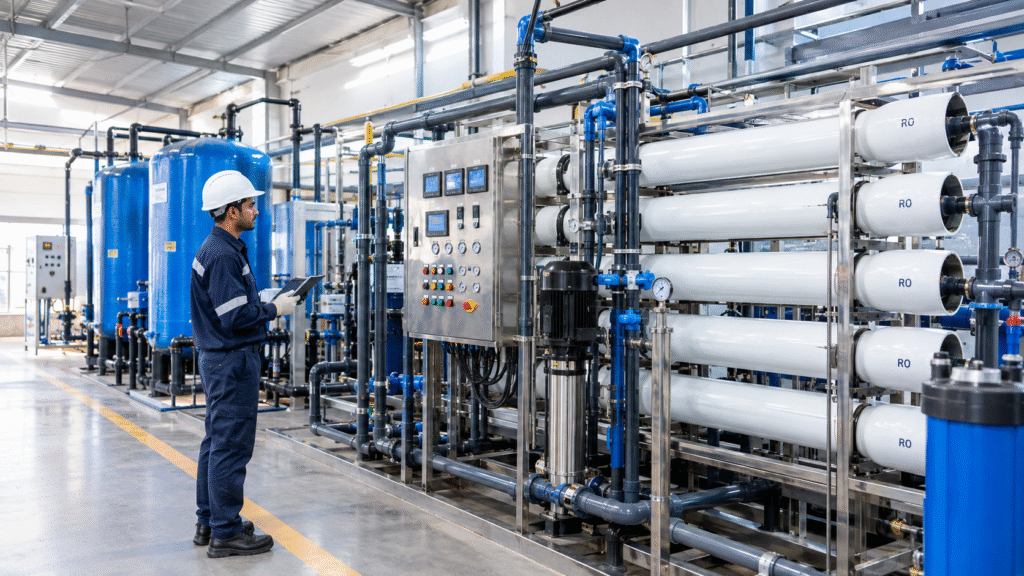
If you’ve ever bought a water treatment plant — RO, STP, ETP, softener, whatever the setup — chances are the vendor mentioned an AMC somewhere in the sales pitch. Most people nod along, sign the papers, and move on without really knowing what they just agreed to.
Then six months later, something breaks. A pump makes a weird noise, the water quality drops, or a filter clogs up faster than it should. That’s usually the moment someone actually reads their AMC document for the first time — and realizes half of what they assumed was “covered” actually isn’t.
So let’s break this down properly. What is an AMC, what should it include, and how do you avoid getting a contract that looks good on paper but leaves you stranded when something actually goes wrong?
What Is an AMC, Really?
An AMC is a yearly agreement between you and the vendor (or a third-party service provider) where they take responsibility for keeping your water treatment plant running — through scheduled visits, servicing, and support when things go wrong.
The idea sounds simple. In practice, the value of an AMC depends entirely on what’s written in the fine print. Two AMCs can look identical on the surface and be worlds apart in what they actually deliver.
What a Proper AMC Should Include
Here’s what a solid, worth-the-money AMC typically covers:
1. Scheduled Preventive Maintenance Visits
This is the core of any AMC — regular visits (monthly, quarterly, or as per plant size) where a technician physically inspects the plant. They check pressure levels, pump performance, valve conditions, and general wear and tear before it turns into a bigger problem.
If your AMC doesn’t specify a visit frequency, that’s a red flag. “As and when required” is not a maintenance schedule — it’s a way for the vendor to visit as little as possible.
2. Filter and Cartridge Replacement
Sediment filters, carbon filters, and cartridges have a shelf life. A proper AMC either includes replacement filters within the cost or clearly states how many replacements are covered per year and what’s charged extra.
Read this part carefully. A lot of vendors count “filter cleaning” as maintenance but bill filter replacement separately — which can add up fast if you weren’t expecting it.
3. Membrane Cleaning and Care
For RO-based systems, membrane health is everything. A good AMC includes periodic membrane cleaning (chemical cleaning-in-place, or CIP) and monitoring for fouling or scaling. Membranes are one of the most expensive components to replace, so this is where preventive care actually saves you money.
4. Chemical Dosing Support
If your plant uses dosing chemicals — antiscalants, biocides, coagulants, pH correctors — the AMC should clarify whether these are supplied, or whether you’re expected to buy and refill them yourself. This is a common point of confusion, and vendors often leave it vague on purpose.
5. Spare Parts Coverage
This is probably the single biggest differentiator between a cheap AMC and a real one. Does the contract cover the cost of spare parts (pumps, motors, valves, sensors), or does it only cover labor and inspection?
Non-comprehensive AMCs usually cover labor only — you pay for parts separately. Comprehensive AMCs include parts up to a certain value or list of components. Always ask which one you’re signing.
6. Emergency Breakdown Support
Plants don’t break down on schedule. A proper AMC should mention response time for breakdown calls — same day, within 24 hours, or otherwise. If the contract is silent on this, you could be waiting days for someone to show up when your plant stops running.
7. Water Quality Testing and Reporting
Especially for industrial ETP/STP setups, many AMCs now include periodic water quality testing (TDS, pH, BOD, COD, depending on the application) with a basic report. This matters if you need documentation for compliance or internal quality checks.
8. Compliance and Documentation Support
For industries operating under Pollution Control Board norms, some AMC providers help maintain logs, readings, and documentation needed for inspections or renewals. Not every AMC offers this — but if compliance is a concern for your business, it’s worth asking for upfront.
Comprehensive vs Non-Comprehensive AMC — The Real Difference
- Non-comprehensive AMC: Covers technician visits and labor. Spare parts, chemicals, and major replacements are billed separately.
- Comprehensive AMC: Covers labor plus parts and consumables up to an agreed value or list. Costs more upfront but avoids surprise bills later.
Neither one is “better” in every case — it depends on the age of your plant, how heavily it’s used, and how much unpredictability you’re willing to tolerate in your maintenance budget.
Questions to Ask Before You Sign
- How many preventive visits are included per year, and what’s the response time for emergencies?
- Are spare parts included, and if so, up to what value?
- Is membrane cleaning included, and how often?
- Are dosing chemicals supplied or billed separately?
- What exactly is excluded from the contract? (This is often more revealing than what’s included.)
- Is there a penalty or additional charge for visits beyond the agreed number?
If a vendor can’t answer these clearly, that alone tells you something about how the contract will play out later.
Final Thought
An AMC isn’t really about paperwork — it’s about whether your plant keeps running the way it’s supposed to, without you having to think about it every other week. A well-structured AMC pays for itself by catching small issues before they become expensive ones. A poorly structured one just adds another bill without actually protecting you.
Before signing anything, get the inclusions and exclusions in writing, ask about spare parts and response time specifically, and don’t assume “AMC” means the same thing across every vendor — because it rarely does.
Keywords: AMC for water treatment plant, annual maintenance contract water treatment, RO plant AMC, STP plant maintenance contract, ETP AMC cost, water treatment plant maintenance India, comprehensive vs non-comprehensive AMC, water treatment plant service contract, RO membrane maintenance AMC, industrial water treatment AMC