
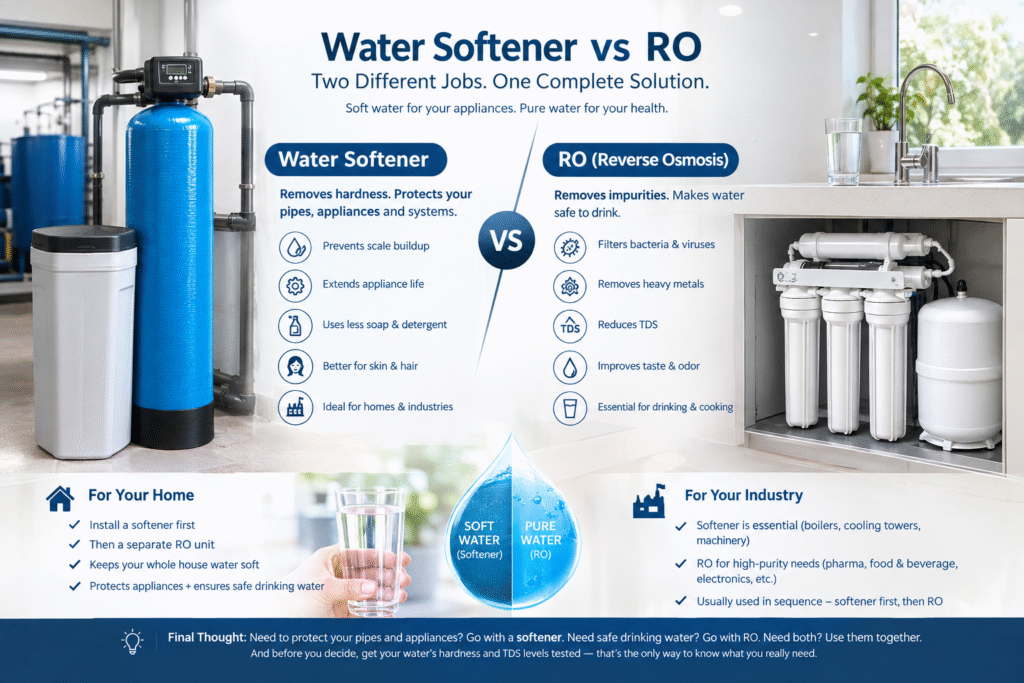
A client asked me last week – “Bro, I heard just installing an RO fixes everything, so what’s this whole water softener thing about?” And honestly, this confusion isn’t limited to just him. Most people assume both do the same job, when actually they solve two completely different problems. One makes water fit to drink, the other keeps your pipes and machines alive for years. Let’s break this down in plain terms.
First, understand what hard water actually is
The water coming out of your tap carries dissolved minerals – mainly calcium and magnesium. When there’s too much of these, the water is called “hard.” That’s exactly why you see that white scaly buildup inside your geyser, why your skin feels dry after a shower, and why soap just doesn’t lather properly on clothes. This is a common issue across Delhi NCR, Gurugram, Rajasthan, and a lot of other regions – there’s a decent chance you’re dealing with it too.
What a water softener actually does
A softener doesn’t make water drinkable – it only removes hardness. It works through an ion-exchange process, where calcium and magnesium get swapped out for sodium. The result is “soft” water, and no more scale buildup in your pipes, geyser, or washing machine.
Honestly, if your main concern is protecting your appliances and you’re fed up with scaling, this should be your first step – even before RO.
A few other benefits worth mentioning:
- Geysers and pipes run for years without scale damage
- You end up using less soap and detergent
- Hard water’s harsh effect on skin and hair is reduced
- Industrial machinery also sees less scaling risk
Now let’s talk about RO
RO, or Reverse Osmosis, does a completely different job. Here, water passes through a fine membrane that filters out dissolved impurities, bacteria, heavy metals, and excess TDS. Put simply – RO’s entire purpose is making water safe to drink.
If there’s someone unwell at home, young kids around, or you suspect the TDS level is high, you can’t skip RO. It’s essential for drinking and cooking water.
So what’s the actual difference
In one line – a softener makes water “soft,” RO makes water “safe/pure.” They solve two different problems, so neither can really replace the other.
A common mistake I’ve seen – people skip the softener entirely and go straight for RO. A few months later, scale starts building up on the RO membrane, and it wears out fast. If a softener is already in place, the RO membrane lasts a lot longer. They actually work best as a team.
What should you get for your home
If your area has hard water, my suggestion would be to install a softener first, and then a separate RO unit for drinking water. Just getting an RO isn’t enough if the water across your whole house is hard – bathing, washing clothes, cleaning dishes all use water too, and RO doesn’t fix hardness there.
Yes, the budget goes up a bit if you install both, but you end up saving on appliance repairs and replacements in the long run, so it balances out.
What should you get for an industry or factory
In a factory or industrial setup, water usage is huge – boilers, cooling towers, machinery, all of it. Hard water almost always causes trouble here, through scaling and corrosion. That’s why a water softener is basically considered essential in industrial settings, especially anywhere boilers are running.
RO comes into play when the process or product needs very high-purity water – think pharma companies, food and beverage units, or electronics manufacturing. In most large setups, water goes through the softener first, then gets purified through RO.
Final Thought
If you want a quick answer – need to protect your pipes and appliances? Go with a softener. Need safe drinking water? Go with RO. And if you need both (which, honestly, is the case for most people), install the softener before the RO so the RO membrane lasts longer too. Before you finalize anything though, get your water’s hardness and TDS levels tested – that’ll tell you exactly what you actually need, instead of guessing.
Keywords: water softener vs ro, what is a water softener, what is an ro system, hard water solution, water softener for home, water softener for industry, RO purifier benefits, best water treatment system, water softener and RO combo, industrial water softener, hardness of water solution, TDS in water, water softener vs RO for home use, water treatment plant, soft water benefits