
“How big a plant do we need?” It sounds like a simple question. Yet it’s the one buyers most often get wrong.
Pick too small, and the plant runs flat out all day, wears out early, and still can’t keep up at peak hours. Pick too big, and you pay extra upfront, then watch the plant sit half-idle and waste power. Neither is what you want.
So here’s a practical way to size a commercial RO plant for a hotel, hospital, school, office, or society, without guesswork.
What Counts as a Commercial RO Plant?
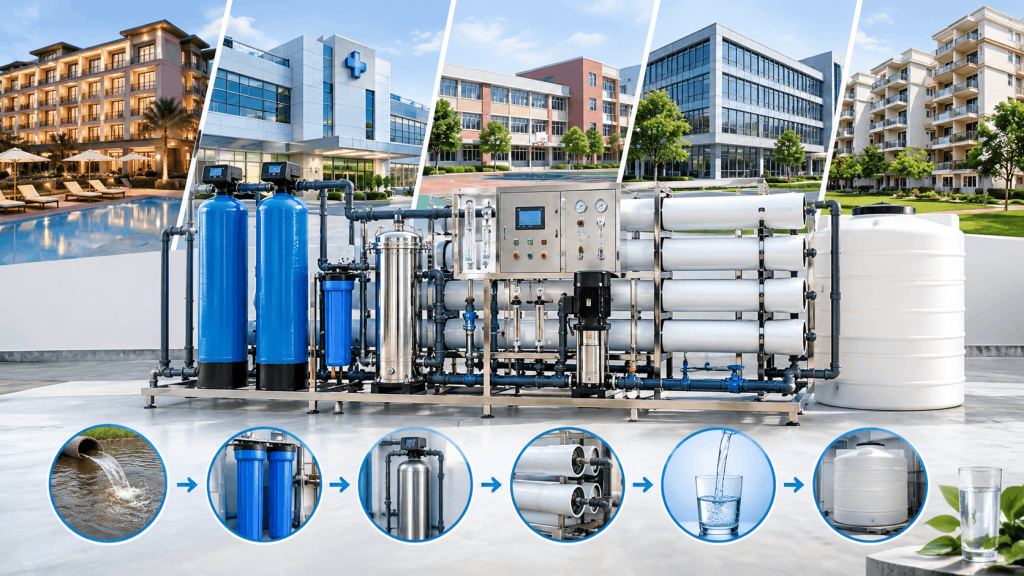
A commercial RO plant sits between a home purifier and a full industrial system. Typical capacities run from around 250 LPH (litres per hour) up to several thousand LPH. People use them in:
- Hotels, restaurants, and banquet halls
- Hospitals and clinics
- Schools, colleges, and hostels
- Offices and corporate campuses
- Residential societies
- Small food and beverage units
- Gyms, malls, and commercial complexes
Step 1: Work Out Your Daily Water Need
Start with people and use. A rough way to count:
- Drinking and cooking water per person per day
- Number of people using the water, including staff, guests, and visitors
- Special uses, such as kitchen, laundry, lab, or dialysis
- Peak demand hours, such as breakfast in a hotel or shift change in a factory canteen
Add everything up to get the total daily requirement. Then ask a second question: is that water for drinking only, or for wider use? RO water costs more to make than plain filtered water, so don’t send it to jobs that don’t need it, like flushing or gardening.
Step 2: Convert Daily Need to Hourly Capacity
Plants are rated in LPH, so convert your daily figure.
Required LPH = Daily requirement ÷ Hours the plant will run
Don’t assume 24 hours. Most commercial plants run 8 to 16 hours a day, so they have rest time for maintenance and flushing.
For example, if you need 6,000 litres a day and plan to run the plant 10 hours, you need about 600 LPH. Add a margin on top.
Step 3: Add Headroom, But Not Too Much
Leave 15 to 25 percent spare capacity. This covers peak demand, membrane ageing over time, and some growth in occupancy. Going far beyond that rarely helps.
Remember that membrane output also changes with temperature. Cold winter water reduces flow, so a plant sized with zero margin can come up short in January.
Step 4: Check Your Raw Water
Capacity isn’t only about volume. Water quality changes the design.
- TDS. Higher TDS needs more pressure and sometimes more membranes.
- Hardness. A softener may be needed to protect the membrane.
- Iron and turbidity. They need filtration before the membrane.
- Chlorine. Municipal water often needs a carbon filter.
Get a proper lab report before finalising anything. Without it, any capacity quote is a guess.
Step 5: Think About Recovery and Reject
Typical commercial plants recover 50 to 75 percent of the feed water as clean water. The rest leaves as reject. If you need 600 LPH of clean water at 60 percent recovery, you’ll need about 1,000 LPH of feed water. Make sure your borewell, tank, or supply line can deliver that.
Also plan what to do with the reject. Many sites reuse it for flushing, washing, or gardening.
Step 6: Plan Storage
A storage tank lets a smaller plant serve a larger peak demand. If your usage spikes in the morning, a well-sized product tank smooths it out. You can often choose a smaller RO plant with a larger tank. That’s usually cheaper than a bigger plant running all day.
Don’t forget hygiene. Clean the tank regularly and keep it covered.
Step 7: Match Features to Your Site
- Manual or automatic. Automation helps where trained staff aren’t always available.
- Output water quality. Some sites add UV disinfection or mineral addition.
- Space and power. Check floor area, ceiling height, and electrical supply.
- Noise. Hospitals and hotels may need quiet equipment.
- Material. Stainless steel suits food and healthcare sites, while FRP works well for general use.
Quick Sizing Table (Rough Guide)
| Site Type | Typical Plant Size |
|---|---|
| Small office or clinic | 250 to 500 LPH |
| School or small hotel | 500 to 1,000 LPH |
| Mid-size hotel, hospital or society | 1,000 to 3,000 LPH |
| Large campus or industrial canteen | 3,000 LPH and above |
Treat this as a starting point only. Your own usage and water quality decide the final size.
Common Sizing Mistakes
- Sizing on average use and ignoring peak hours
- Assuming the plant will run 24 hours a day
- Forgetting that reject water increases the feed requirement
- Skipping the raw water test
- Using RO water for tasks that don’t need it
- Buying the biggest plant “to be safe”
Final Thought
Right-sizing a commercial RO plant comes down to a few honest numbers: how much water you really use, when you use it, and what your raw water looks like. Work those out, add a sensible margin, and use storage to handle peaks. You’ll end up with a plant that runs comfortably, costs less to operate, and keeps up when demand rises.
Keywords: commercial RO plant, commercial RO plant capacity, how to size RO plant, RO plant for hotel, RO plant for hospital, RO plant for school, commercial RO plant LPH, commercial RO plant price, commercial RO plant manufacturer in Gurgaon, RO plant for society