
Here’s a question operators ask all the time: “Our DM plant runs fine, so why add a degasser?”
It’s a fair question. The plant does produce demineralised water, after all. But if you look at what it costs to produce that water, the story changes. A degasser sits quietly between the cation and anion units, and it can cut your caustic soda bill, stretch your resin life, and keep your treated water quality steady. Let’s see how it works and why it belongs in almost any DM plant design.
What Is a Degasser?
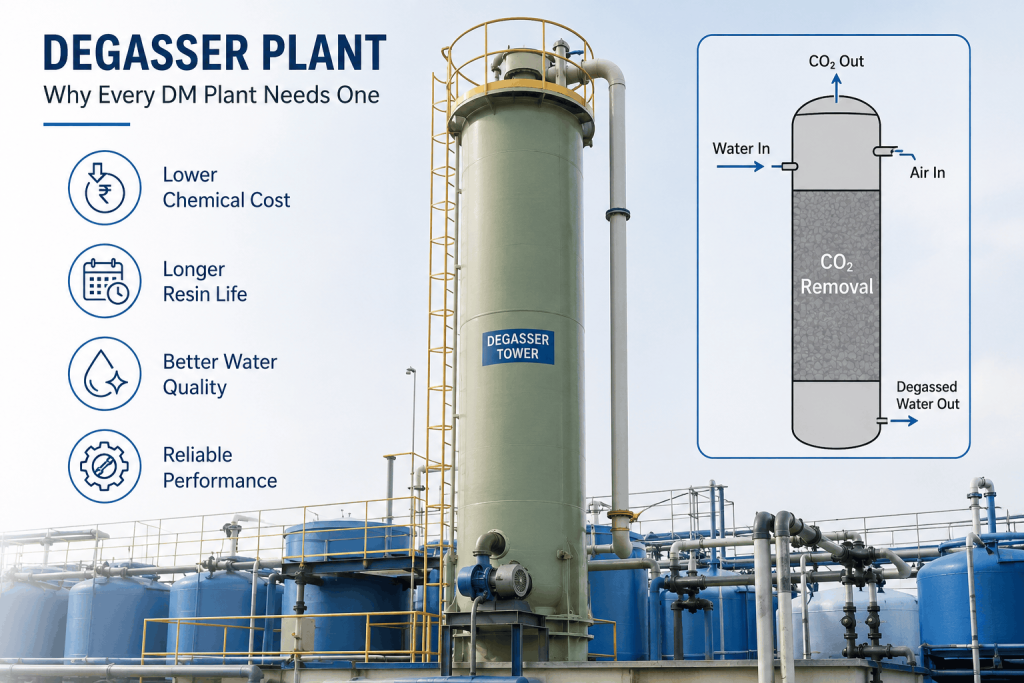
A degasser, also called a decarbonator or degasifier, removes dissolved carbon dioxide (CO₂) from water. It’s usually a tall vertical tower filled with packing media. A blower pushes air up through the tower while water trickles down over the packing.
The air carries the CO₂ out through the top vent. The water that collects at the bottom holds far less dissolved gas than the water that went in. There’s no chemical and no membrane involved, just air and good contact between air and water.
Where Does the CO₂ Come From?
Most raw water carries bicarbonate alkalinity. When that water passes through a strong acid cation (SAC) exchanger in a DM plant, the resin swaps the metal ions for hydrogen ions. The bicarbonates then turn into carbonic acid, which breaks down into free CO₂ and water.
So the water leaving the cation unit is acidic and loaded with dissolved CO₂. Without a degasser, all of that gas flows straight on to the anion resin.
Why That’s a Problem
The anion exchanger has to deal with that CO₂. It captures the carbonic acid as if it were any other acid, and that eats up resin capacity. Here’s what you notice on the plant:
- Higher caustic soda use. The anion resin fills up faster, so you regenerate more often and use more caustic every cycle.
- Shorter service runs. The resin spends its capacity on CO₂ instead of the silica and other anions you actually care about.
- Faster resin wear. Frequent regeneration stresses the beads and shortens their life.
A degasser removes most of that CO₂ before it reaches the anion bed. The anion unit then handles a much lighter load, and the savings repeat on every cycle.
How a Degasser Plant Works
The process is simple and reliable:
- Water leaves the cation unit and enters the top of the degasser tower.
- A distributor spreads the water evenly over the packing.
- A forced draft blower pushes air upward through the packing.
- CO₂ moves from the water into the air and exits through the top vent.
- Degassed water collects in a sump at the bottom of the tower.
- Transfer pumps then send it to the anion exchanger.
A well-designed unit cuts CO₂ down to very low levels, often below 5 to 10 mg/L. The packing creates a huge surface area, so the water and air touch more, and the gas leaves faster.
Does Every DM Plant Really Need One?
For nearly all plants working with groundwater or municipal supply, yes. Natural water almost always carries some bicarbonate, and the CO₂ it releases is a steady burden on the anion bed. A degasser is a small addition to the total plant cost, and it usually pays for itself through lower chemical use.
The case gets even stronger when:
- Alkalinity is moderate or high. The more bicarbonate, the more CO₂ to remove.
- Flow rates are large. Bigger plants save more chemical in absolute terms.
- The plant regenerates often. Frequent regeneration is a sign the anion bed is overworked.
Only in unusual cases, such as extremely low alkalinity water or a very small plant, might the numbers fail to justify it. A proper raw water analysis settles the question, so don’t guess.
What to Look for in a Degasser Design
- Correct tower size. Diameter and packing height must match your flow rate.
- Good packing media. It should resist fouling and keep an open structure.
- A suitably sized blower. Airflow decides how much CO₂ you actually remove.
- An even water distributor. Poor distribution creates dry spots and wastes the packing.
- Corrosion-resistant construction. The water is slightly acidic, so FRP or lined tanks work well.
- Adequate sump and pumps. The sump should hold enough water to keep the anion unit fed steadily.
Simple Maintenance Tips
A degasser needs little attention, but it isn’t maintenance-free.
- Check the blower and motor regularly.
- Inspect the packing for scale, algae, or blockage.
- Keep air inlets clear of dust and debris.
- Clean the sump periodically.
- Compare pH or CO₂ levels before and after the tower to confirm it’s working.
A clogged or neglected degasser silently pushes the CO₂ load back onto your anion resin, and you only notice when the chemical bill climbs.
Final Thought
A degasser isn’t a luxury add-on. For most DM plants, it’s the part that keeps your regeneration chemical bills under control and protects the anion resin. Test your raw water alkalinity, look at how often you regenerate, and ask your plant designer to show the numbers with and without a degasser. In most cases, the numbers make the decision for you.
Keywords: degasser plant, degasser in DM plant, decarbonator tower, CO2 removal from water, forced draft degasser, DM plant resin life, DM plant caustic consumption, degasser tower working, vacuum degasser, DM plant manufacturer in Gurgaon