
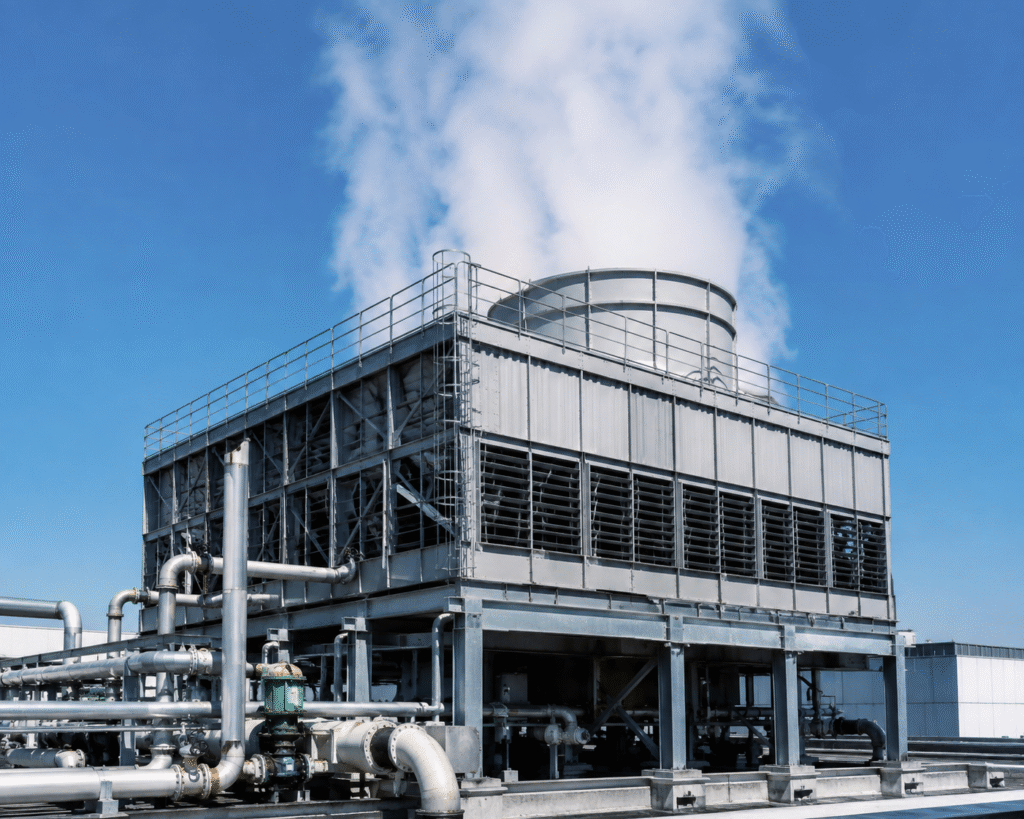
Most people walk past cooling towers every day and never really notice them. You’ve seen them, on rooftops, outside factories, near power plants. Tall structures, fans on top sometimes, open lattice sides. They look kind of boring from the outside, if I’m being honest. But inside, there’s real work happening. And if you’re running any kind of industrial or commercial setup, knowing how these things work can save you a lot of money. And a lot of headaches too.
Let’s get into it.
So What Exactly Is A Cooling Tower?
Put simply, a cooling tower is a heat rejection device. It pulls extra heat out of water that’s already been used to cool machinery, HVAC systems, or whatever industrial process needs cooling. Picture a large factory, or even a big office building. Machines run, machines generate heat, and water absorbs that heat as it moves through the system. Once it’s hot, that water travels to the cooling tower, gets cooled back down, and heads right back to do its job again.
How does it actually cool? Air and water meet each other, that’s really the core of it. Hot water flows down through the tower while air moves through, sometimes on its own, sometimes pushed along by fans. Some of that water evaporates in the process, and evaporation pulls heat away from whatever water is left. It’s basic physics honestly. Evaporation cools things down. Cooling towers just take that idea and run it at a much larger scale.
Why Do Industries Rely On Them So Much?
Take away cooling towers, and a lot of industrial processes would overheat pretty fast. Power plants, chemical plants, oil refineries, food processing units, large commercial buildings, all of them generate serious heat just from day-to-day operations. Cooling towers keep equipment running at safe temperatures. They protect machinery from damage. They help keep production quality consistent, which matters more than people think.
They’re also surprisingly water-efficient. A well-designed cooling tower recirculates the same water instead of constantly pulling in fresh supply, which makes it a genuinely sustainable option for large operations. Not something people usually associate with “industrial equipment,” but there it is.
Now Here’s Where Water Quality Comes In
And this is the part people tend to underestimate. You could build the most perfectly engineered cooling tower out there, but if the water running through it is low quality, the whole system takes a hit. Water quality isn’t some small detail tucked away in a maintenance manual. It directly decides how well the tower performs, and honestly, how long it even lasts.
Scaling Is A Real Problem
Hard water carries minerals, calcium, magnesium, that sort of thing. When this water keeps evaporating inside a cooling tower over and over, those minerals don’t evaporate with it. They stay put. Build up. Over time, this creates scale deposits across pipes, heat exchangers, and other tower components. Scale basically acts like insulation, so heat transfer becomes less efficient. Your system has to push harder to get the same cooling result, and that shows up directly on your energy bill.
Corrosion Eats Away At Your Investment
Bad water chemistry, think low pH or high dissolved oxygen, corrodes the metal parts inside the tower and the piping connected to it. Corrosion weakens structural components over time, causes leaks eventually, and forces you into expensive repairs or full replacements down the line. Nobody wants to discover a corroded pipe in the middle of an unplanned shutdown. That’s a bad day for everyone involved.
Biological Growth Is A Bigger Risk Than People Realize
Cooling towers are basically the perfect breeding ground for bacteria, algae, and other microorganisms. Warm water, constant moisture, open air, it checks every box. When water quality isn’t managed well, this biological growth clogs pipes, drags down efficiency, and in the worst cases, turns into a genuine health hazard. Legionella bacteria is a good example, it thrives in poorly maintained cooling tower water and has actually caused real public health outbreaks in the past. This is not something to shrug off.
Fouling Reduces Efficiency Quietly
Beyond scale and biological buildup, plain old dirt, dust, and debris pile up inside the system too, given enough time. This fouling reduces water flow and cuts heat transfer efficiency, and the frustrating part is nobody usually notices until performance drops or the energy bill jumps unexpectedly.
What Good Water Management Actually Looks Like
Managing water quality doesn’t have to be complicated. It just needs consistency, that’s really the whole trick. Regular water testing tracks pH levels, mineral content, and microbial activity before any of it turns into a bigger problem. Chemical treatment programs, done right, handle scaling, corrosion, and biological growth all together. Routine cleaning schedules keep debris from quietly piling up. And filtration systems catch contaminants before they even get into the main system in the first place.
Operators who actually take water quality seriously tend to see fewer breakdowns, lower energy use, and equipment that lasts noticeably longer. It’s one of those things where a small, steady effort saves a much bigger cost later.
Final Thoughts
A cooling tower has one job, and it does that job well when everything around it is properly managed. Water quality isn’t some side concern, it’s genuinely central to how safely and efficiently the whole system runs. Scaling, corrosion, biological growth, fouling, every one of these can be prevented with the right monitoring and treatment, and prevention almost always costs less than fixing the damage later. So if you’re running a cooling tower system, big or small, water quality deserves just as much attention as the mechanical side of things
Keywords: cooling tower water quality, what is a cooling tower, cooling tower scaling, cooling tower corrosion, cooling tower maintenance, industrial cooling tower, cooling tower water treatment, Legionella cooling tower, cooling tower efficiency, cooling tower biological growth