
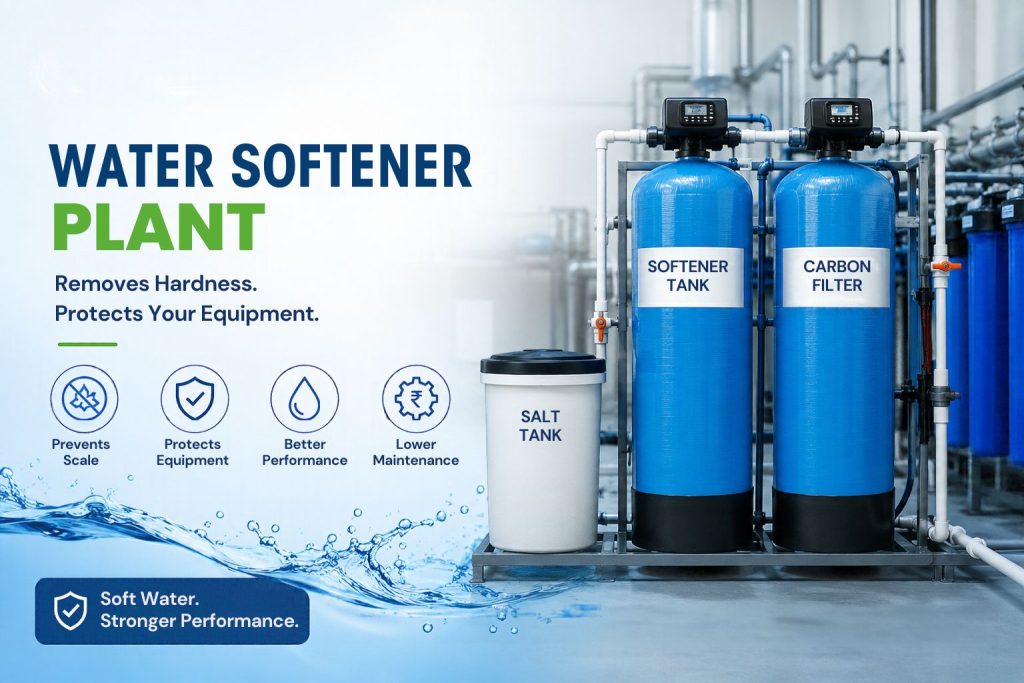
Open a boiler that has run on hard water for a year and you’ll find a grey-white crust on the tubes. It looks harmless. It isn’t. That layer works like a blanket, so the metal underneath overheats, fuel use goes up, and one day a tube gives up.
The cause is hard water. The fix, in most plants, is a water softener plant. This guide explains what hardness is, how a softener removes it, and how to choose the right one for your site.
What Is Hard Water?
Hard water contains dissolved calcium and magnesium salts. They aren’t harmful in normal amounts, but they cause trouble once the water is heated, evaporated or pushed through equipment.
Hardness is measured in ppm as CaCO₃. Roughly, below 60 ppm is soft, 60 to 120 is moderately hard, 120 to 180 is hard, and above 180 is very hard. Borewell water across Gurgaon and Delhi NCR often falls in the very hard range.
Why Hardness Gets Expensive
Scale doesn’t announce itself. It builds slowly, and the damage shows up as higher bills and sudden breakdowns.
- Boilers: Scale reduces heat transfer, so you burn more fuel for the same steam. Thick deposits can cause tube failure.
- Cooling towers and heat exchangers: Scale cuts cooling efficiency and blocks fill and nozzles.
- RO membranes: Calcium and magnesium can precipitate on the membrane and damage it permanently.
- Pipes and pumps: Deposits narrow the flow path and raise pumping energy.
- Laundry and kitchens: Soap use rises, linen turns stiff, and fittings get white spots.
Preventing scale costs far less than removing it. That’s the whole case for softening.
How a Softener Works
A softener uses ion exchange. Inside the vessel is a bed of strong acid cation resin, tiny beads that hold sodium ions. When hard water flows through, the resin grabs calcium and magnesium and releases sodium in exchange. Sodium salts don’t form scale, so the outgoing water is soft.
Nothing is added except a small amount of sodium. The hardness is simply swapped out.
The Regeneration Cycle
A resin bed can only hold so much hardness. When it’s full, it must be recharged, which follows four steps:
- Service run: Hard water passes through and comes out soft.
- Backwash: Water flows upward to loosen the bed and flush out dirt.
- Brine draw and slow rinse: A salt solution pushes the calcium and magnesium off the beads and sends them to drain.
- Fast rinse: Clean water washes out leftover brine, and the unit returns to service.
Most plants use automatic valves that trigger regeneration by timer or treated volume. Large systems use twin units, so one is always in service.
What Quality to Expect
A well-designed softener typically brings treated hardness below 5 ppm, often under 1 ppm. That suits boilers, chillers and RO pre-treatment.
One limit to remember: a softener removes hardness only. It doesn’t reduce TDS, chlorides, silica or bacteria. For low-TDS or demineralised water you need RO or a DM plant, and the softener usually goes in first to protect them.
Softener, DM or RO: Which One Do You Need?
A softener removes hardness only and is the most economical option. It suits low-pressure boilers, cooling towers and laundries. RO cuts total dissolved solids and suits process and drinking water. A DM plant removes almost all ions and is used for high-pressure boilers and sensitive processes. Often they work together, with the softener first, then RO or DM. If you’re unsure, a water analysis settles it.
A Simple Sizing Example
Sizing needs flow rate, inlet hardness and the run time you want between regenerations. Say a plant needs 5 m³/hour and raw hardness is 300 ppm.
Hardness load per hour is 300 g/m³ × 5 m³/h = 1,500 g, or 1.5 kg. Over an 8-hour run, that’s 12 kg. Strong acid cation resin gives roughly 40 to 50 kg of working capacity per cubic metre at normal salt dosing, so you need about 250 to 300 litres of resin in a vessel with enough free board for backwash.
This is only an illustration. Real designs also consider peak flow, service velocity and salt dose, and a proper water test should always come first.
Mistakes That Shorten Softener Life
- Ignoring iron: It coats the resin and kills capacity. Remove it before the softener.
- Chlorine in the feed: It slowly damages resin. A carbon filter ahead protects it.
- Poor salt: Dirty or wet salt chokes the injector and brine tank.
- Skipping hardness tests: Water quality shifts with season and source, so test treated water regularly.
- Wrong salt dose: Too little leaves resin weak, too much wastes money and water.
Good resin lasts several years. Warning signs are shorter run times, rising hardness after regeneration, and broken or discoloured beads.
Frequently Asked Questions
Does a softener remove TDS?
No. It removes calcium and magnesium only.
Can it replace an RO plant?
No. They solve different problems, and many plants use both.
Do I need a softener before an RO?
Usually, if the feed water is hard. Without it, scale can ruin membranes quickly.
How often should it regenerate?
It depends on flow, hardness and resin volume. Many plants regenerate once a day.
Is softened water safe?
Yes for industrial and general use. It carries a little extra sodium, which matters only for strict low-sodium diets.
Final Thoughts
Hard water rarely causes a dramatic failure on day one. It quietly eats into efficiency, fuel, spares and uptime, and the bill arrives later. A well-designed water softener plant is one of the cheapest ways to protect boilers, chillers, cooling towers and RO systems.
Get the basics right: test your water, size the unit for real flow and hardness, protect the resin from iron and chlorine, and keep up simple maintenance. If you’re unsure what your plant needs, Epic Aquatech can test your water and recommend the right setup. Explore our Water Softening Plant Manufacturer services.
Contact Epic Aquatech
Q 66, 2nd Floor, New Palam Vihar Phase 1, Gurgaon, Haryana – 122017
Phone: +91-9355260599
Email: info@epicaquatech.com
Keywords: water softener plant, water softening plant manufacturer, industrial water softener, hard water treatment, ion exchange softener, boiler feed water softener, softener plant Gurgaon, hardness removal, scale prevention, cation resin